
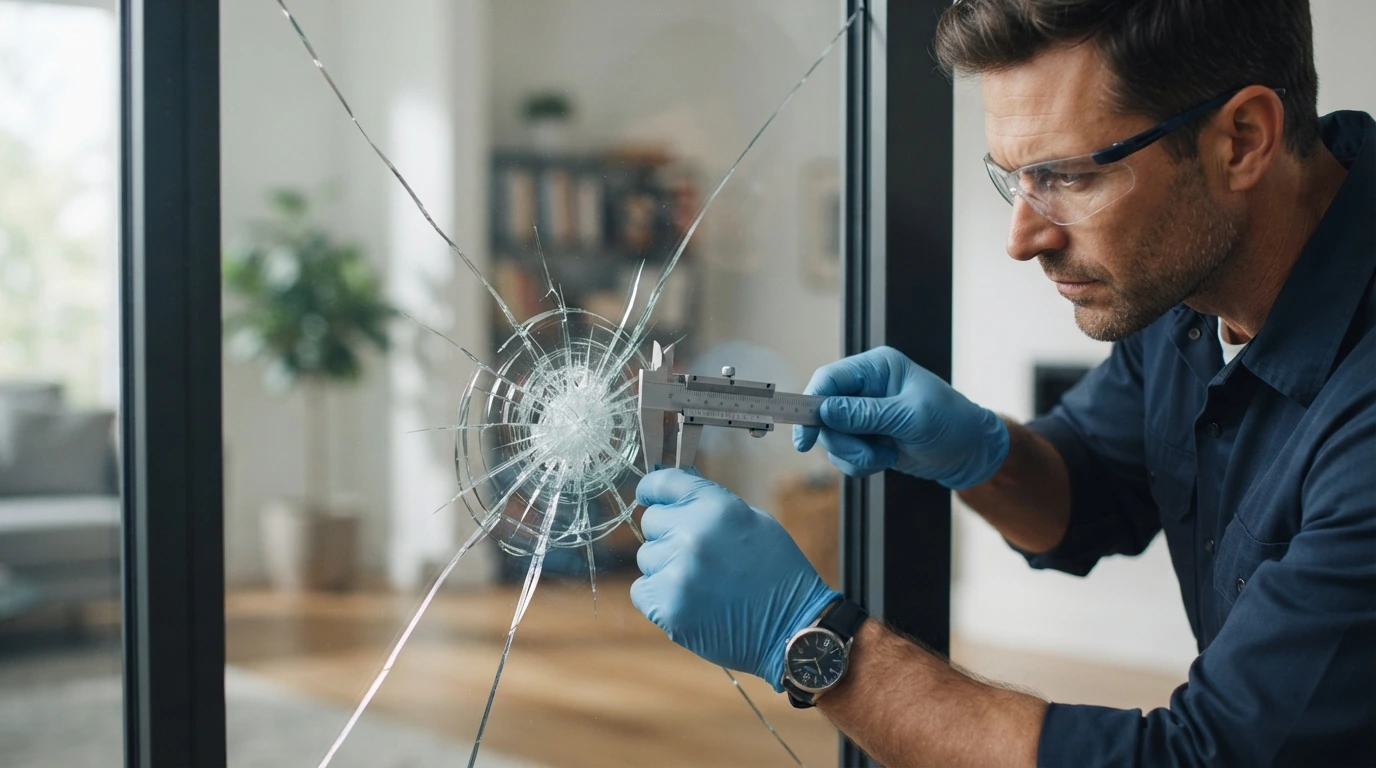
You noticed this morning a crack running across your window that definitely wasn’t there last week. Or maybe it was, and you’ve been telling yourself it’s fine, waiting to see if it gets worse.
The problem is, most people have no idea how to read a glass crack. Is it serious? Can it be repaired? Did something hit it, or did it appear out of nowhere? And the big one: can it wait, or does it need attention right now?
Here’s something worth knowing: when a glass professional looks at a crack, they aren’t just measuring it. They’re reading it. The size tells one part of the story. The location tells another. The pattern, the shape, the direction, where it started tells the rest. Together, those three signals give a trained eye a remarkably clear picture of what happened, why it happened, and what needs to be done about it.
This article walks you through exactly what professionals look for, and why understanding those signals helps you make a smarter, safer decision about your glass.
Why Professionals Look at More Than Just the Size
When most people spot a crack, the first instinct is to measure it. A small crack is probably fine. Big crack probably needs fixing. That logic makes sense, but it’s incomplete.
A crack the length of your finger in the center of a large window pane may be less urgent than a two-inch crack running from the edge. A tiny chip in a corner can compromise an entire pane. A crack that looks dramatic across the surface may actually be contained and stable, while a subtle line near the frame could be actively growing.
Professional glass assessment is built around three questions asked simultaneously: How big is this damage? Where exactly is it? And what does the crack pattern tell me about how it got there?
The answers to those three questions read together determine whether a pane needs monitoring, repair, or immediate replacement. No single factor alone gives the full picture.
What the Size of a Crack Actually Tells a Professional

When Size Alone Is Misleading
Size matters, but not the way most people assume.
There are general thresholds professionals use as starting points. A small chip roughly the size of a coin in a safe location on a laminated windshield is often repairable. A linear crack under a few inches may be a repair candidate if conditions are favorable. Longer cracks, or those that have spread across a significant portion of the pane, tend to move into replacement territory.
But here’s the critical thing most people don’t realize: those thresholds only apply when the location and pattern are also within acceptable ranges. A crack that’s technically “small” at the edge of a window, or within a structurally critical zone, may require full replacement regardless of its length. And a crack that looks alarmingly long in the center of a large commercial pane may actually be stable and repairable.
Size tells the professional how much glass surface has been disrupted. It doesn’t tell them whether the glass is structurally sound.
How Size Relates to Crack Progression Risk
Where size genuinely matters is in predicting how quickly a crack is likely to grow.
Larger cracks have more surface area for stress to act on. Every temperature change, vibration from traffic or wind, and small shifts in the surrounding frame puts mechanical pressure along the full length of that fracture. A longer crack is, almost by definition, harder to stabilize and more likely to extend further.
This is why professionals treat size partly as a time indicator. A short crack that hasn’t reached a critical location may be stable for now but the window for repair narrows quickly. Glass doesn’t sit still. The longer you wait, the more likely you are to cross from a repair into a replacement scenario.
What the Location of a Crack Actually Tells a Professional
If size is the first question, location is the question that most often changes the answer.
Edge Cracks The Most Urgent Location
A crack that starts at the edge of a glass pane, or extends to reach the edge, is one of the more serious findings a professional will encounter.
Here’s why: the edge is the most structurally loaded part of any glass pane. It sits within the frame, absorbs thermal expansion and contraction, and bears the physical forces of installation and everyday use. The edges of glass are also particularly vulnerable during handling and installation; small chips, abrasions, or “oyster” damage (tiny clamshell-shaped edge chips) can occur without anyone noticing, and those microscopic weaknesses become the starting point for cracks that appear weeks or months later.
When a professional sees a crack originating at the edge, they know two things immediately. First, there’s likely pre-existing edge damage at the origin point even if it’s not visible to the naked eye. Second, this crack has access to one of the most stress-active zones of the pane, which means it tends to spread faster than cracks that begin in the open field of the glass.
Edge cracks, in most cases, indicate that replacement is the appropriate solution. Repair is rarely viable, because the structural loading at the edge makes it impossible to fully stabilize the fracture.
Corner Cracks Why the Intersection Matters
Corners are where two edges meet, which means they concentrate stress from two directions at once. Glass that cracks at or near a corner has lost structural support from multiple angles simultaneously.
A professional will almost always recommend replacement in this scenario. The corner region is too mechanically compromised for repair to restore meaningful integrity, regardless of how short the crack appears at first.
Center and Field Cracks A Different Story
A crack that originates in the open field of the glass away from edges and corners is inherently in a more stable location. The surrounding glass can still provide structural support, and the crack isn’t subject to the same edge-loading forces.
This doesn’t mean center cracks are automatically minor. Their pattern tells the professional a great deal about cause and likely behavior. But as a starting point, a crack well away from the edges begins the assessment in a better position than one at the perimeter.
Location in Safety-Critical Areas
Some glass performs a safety function that changes the calculus entirely.
In automotive glass, any damage in the driver’s direct sightline, the zone directly in front of the steering wheel, is treated with particular caution. Even a crack that might otherwise be repairable can require replacement if a repair would leave optical distortion in that critical viewing area.
In residential and commercial glass, the same principle applies to shower enclosures, glass railings, glass floors, load-bearing structural panels, and any glass where failure could mean physical harm. In these applications, the acceptable tolerance for any remaining weakness is significantly lower, and replacement is often the right call even when the damage is limited in size.
What the Pattern of a Crack Actually Tells a Professional
This is where glass assessment becomes genuinely fascinating. The pattern of a crack, its shape, its origin point, the way it radiates or wanders is essentially a record of what the glass experienced. A trained professional can read that record with surprising accuracy. According to engineering analysis published in STRUCTURE Magazine, low-stress thermal cracks are typically oriented perpendicular to the glass edge, while mechanical impact cracks tend to run at a non-perpendicular angle, a distinction that allows professionals to differentiate thermal failure from impact damage even when no external cause is immediately obvious.
Impact Patterns The Telltale Bullseye and Star
When something strikes glass with enough force, the energy radiates outward from the point of contact. The result is a characteristic pattern: lines extending outward from a central point, often with a circular or semi-circular ring surrounding the origin.
A bullseye pattern, a circular break with rings, like a target indicates a direct, concentrated impact. A star pattern with multiple short lines radiating from a center suggests a sharper, higher-velocity impact. These patterns are the glass industry’s equivalent of a fingerprint at a scene. They tell the professional not just that something hit the glass, but roughly how hard, from which direction, and whether the force came from the interior or exterior side.
This matters practically: if there’s a dispute about how damage occurred in a rental property, a commercial space, or an insurance claim situation the crack pattern is often the most reliable piece of evidence available.
What a professional won’t assume is that the presence of an impact pattern automatically means repair is the answer. Impact cracks are evaluated on all three factors: size, location, and depth of penetration. A bullseye in the center of a residential pane is very different from one at the edge, or in the driver’s sightline of a vehicle.
Stress and Thermal Crack Patterns The Wanderers
Stress cracks look nothing like impact cracks. There’s no center point, no radiating lines, no bullseye. Instead, a stress crack typically begins at the edge of the pane and travels in a long, somewhat wandering line across the glass, sometimes curving gently, changing direction slightly, but never emanating from a single concentrated source.
When a professional sees this pattern, they immediately think: this crack wasn’t caused by something hitting the glass. It was caused by forces within the glass.
The most common source is thermal stress. Glass expands when it heats up and contracts when it cools. When one part of a pane heats faster than another, the sun illuminates the center while the edges remain cooler inside the frame; the differential expansion creates internal tension. If that tension exceeds what the glass can bear, it cracks, starting where the glass is weakest: the edge.
Reflective blinds or curtains that partially cover a window can make this dramatically worse, creating hot spots on the exposed glass while shaded sections remain cool.
The important thing a professional understands here is that a thermal stress crack is a symptom, not just damage. The crack tells them the glass was likely the wrong specification for the installation or that the installation conditions (shading, frame material, solar exposure) were placing thermal loads beyond what the glass was designed to handle. Replacing the glass without addressing that underlying condition often means the new glass will crack too.
Spontaneous Breakage Patterns When Glass Breaks Itself
Tempered glass the type used in shower doors, glass doors, and many modern windows, is manufactured through a rapid heating and cooling process that creates a layer of surface compression. This makes it significantly stronger than standard annealed glass and, when it does break, causes it to shatter into small, blunt-edged cubes rather than sharp dangerous shards.
But tempered glass has a known vulnerability: nickel sulfide inclusions. These are tiny impurities occasionally present in the raw glass material. During the tempering process, these particles change their crystalline structure. Years later, they can continue expanding inside the compressed glass, eventually triggering a spontaneous fracture with no external cause.
When a professional examines the aftermath of spontaneous breakage in tempered glass, they look for a distinctive “butterfly” or “cat-eye” pattern at the fracture origin of two small adjacent fragments with a particular shape surrounding the inclusion point. This pattern tells them the breakage was internal in origin, not caused by impact or misuse.
This distinction matters significantly for building owners, property managers, and anyone dealing with an insurance claim. A crack pattern that reveals spontaneous internal failure tells a completely different story than one that shows impact damage.
Branching and Multiple Cracks Reading High-Energy Events
When a crack branches into multiple directions, or when several distinct cracks appear simultaneously, the professional’s assessment shifts considerably.
Branching cracks indicate that the energy involved in the fracture event was high high enough to drive the fracture in multiple directions at once. Multiple simultaneous cracks suggest either an extreme external force or accumulated stress across the pane that reached a tipping point at several weak points at the same time.
In either case, complex branching or multi-crack patterns almost always indicate that full replacement is the correct path forward. The glass has experienced a structural event significant enough that repair cannot restore reliable integrity.
How the Three Factors Work Together in Practice
Here’s where the real professional judgment comes in. Size, location, and pattern are each informative on their own. Together, they tell a complete story.
Consider three different cracks, each roughly the same length:
Scenario one: A short crack in the center of a large window pane, with a clear bullseye origin point. The pattern says impact. The location says it is a structurally stable zone. The size is within potential repair range. A professional looks at this and sees a plausible repair candidate assuming depth assessment confirms the damage hasn’t penetrated through both panes.
Scenario two: The same length crack, but it starts at the edge of the glass and wanders across the surface with no clear impact point. The pattern says thermal or stress crack. The location says edge origin high structural risk, likely to spread. The size is almost irrelevant here. A professional sees a replacement situation and, importantly, a need to investigate why the thermal stress occurred so the replacement glass doesn’t meet the same fate.
Scenario three: Tempered glass, shattered into small cubed fragments, with a butterfly pattern cluster visible at the origin. The pattern says spontaneous internal failure. The glass needs full replacement, and the professional may recommend documenting the fracture evidence for potential warranty or insurance purposes.
Same approximate size. Three completely different professional responses driven by location and pattern.
Warning Signs That Mean You Shouldn’t Wait
Some crack characteristics indicate that professional attention is needed promptly, not eventually.
- The crack starts at, or has reached, the edge of the pane. Edge cracks are structurally active and spread faster than center-field cracks. They are also among the most common causes of unexpected full pane failure.
- The crack is in a corner. Corner cracks compromise structural support from multiple directions simultaneously. Don’t monitor these have them assessed immediately.
- The glass is in a safety-critical location. Shower enclosures, glass railings, glass floors, and glass doors are all applications where unexpected failure poses a direct physical risk. Any crack in these applications warrants urgent professional review.
- The crack is visibly growing. If you mark the end of a crack and it has moved, the glass is under active stress. That stress isn’t going to resolve on its own.
- You have a double-pane or insulated glass unit. A crack in one pane of a double-pane unit compromises the sealed air space between the panes. The result is moisture intrusion, fogging, and energy loss none of which are immediately obvious but all of which progress over time.
- Water, drafts, or glass movement are present. Any of these signals that the crack has compromised the integrity of the installation, not just the glass itself.
What Happens During a Professional Glass Assessment
Many people put off calling a professional because they’re not sure what the visit involves or whether it’s worth it for what might turn out to be “nothing.” It’s worth knowing what actually happens.
A professional glass assessment begins with visual identification of the crack’s origin point where it started, not just where it currently ends. Identifying the true origin is what determines the cause, and the cause determines the correct response.
The professional then evaluates the glass type annealed, heat-strengthened, tempered, laminated, or insulated unit because different glass types have different risk profiles and different repair possibilities. Tempered glass, for example, cannot be partially repaired; if the structural integrity is compromised, it needs full replacement.
Location and pattern analysis follows, reading the crack against the context of the full installation: what is the glass doing, where is it positioned, and what stresses is it subject to in that environment?
The frame and surrounding structure are also assessed. A crack that was triggered by frame movement, settlement, or improper installation will recur in replacement glass unless the underlying condition is addressed.
At Hansen Glass, this kind of thorough assessment is part of how we approach every situation looking at the full picture rather than just the visible damage, so the recommendation we give is the right one for the long term.
The Hidden Cost of Waiting
It’s genuinely tempting to watch a crack for a while. Maybe it won’t spread. Maybe it’s been stable for a week already.
The problem is what happens inside the crack while you’re watching.
Temperature changes even the normal cycle of daytime warming and nighttime cooling cause glass to expand and contract. That movement flexes the crack open and closed slightly with every cycle, gradually advancing the fracture. Vibration from traffic, wind, or nearby machinery has the same effect.
Moisture enters the crack and works its way deeper into the fracture. In laminated glass, moisture can begin to compromise the interlayer. In an insulated unit, even a hairline crack can eventually breach the perimeter seal, allowing moisture into the air space between panes which leads to fogging that cannot be reversed without full unit replacement.
And practically speaking: a crack that falls within the repairable range today may cross into replacement territory by next month simply because it has spread, because contamination has entered the fracture, or because the damage has advanced to the edge.
Getting a professional assessment early when options are still open is nearly always the better outcome. Hansen Glass offers professional evaluation so you know exactly what you’re dealing with before the window of opportunity closes.
Conclusion
A crack in your glass is more than damage. It’s information.
The size tells a professional how much structural surface has been compromised and how urgently the situation needs attention. The location tells them where the structural risk lies whether the crack is in a stable zone or an area where the glass is already under load. The pattern tells them what actually happened: was it impact, thermal stress, edge damage, or an internal flaw in the glass itself?
Read together, those three signals give a trained professional a clear picture clear enough to tell you with confidence whether your glass needs monitoring, repair, or replacement, and whether there’s an underlying cause that needs addressing before a new pane goes in.
If you’ve noticed a crack in your windows, glass doors, shower enclosure, or any other glass installation, the right first step is a professional assessment. Photograph the crack before anything changes, keep the area clear, and don’t apply pressure or DIY products to the fracture contamination makes professional repair significantly more difficult.
The team at Hansen Glass can evaluate the full picture: size, location, pattern, glass type, and frame condition. We’ll give you an honest assessment of what you’re dealing with and what the right path forward looks like. Get in touch and let’s take a proper look.
Frequently Asked Questions
Can a small crack in my window always be repaired, or does location change that?
Size is only one part of the assessment. A small crack at the edge of a pane or in a corner, or within a safety-critical application like a shower enclosure or glass railing may require full replacement even if its length would otherwise suggest it’s repairable. A longer crack in a stable, central location might actually be the better repair candidate. This is exactly why professional evaluation considers all three factors: size, location, and pattern before any recommendation is made.
What does it mean if my glass cracked without anything hitting it?
Two causes are most common. The first is thermal stress: uneven heating across the pane often from partial sun exposure, nearby heat-reflective surfaces, or seasonal temperature swings creates internal tension that cracks the glass, typically starting at the edge. The second, in tempered glass specifically, is spontaneous breakage from a nickel sulfide inclusion, a tiny manufacturing impurity that expands inside the glass over time until the glass fractures. Both causes are identifiable from the crack pattern, which is why professional examination of the crack is important before any conclusions are drawn.
How do I know if my cracked double-pane window needs full replacement?
Any crack in a double-pane or insulated glass unit should be assessed professionally, even if the crack appears minor. The outer glass is only part of the system. The sealed air space between the two panes is what provides thermal performance, and a crack or even a hairline fracture can compromise that seal over time, allowing moisture to enter the space between panes. The result is fogging and condensation that appears between the panes, which cannot be corrected without replacing the full sealed unit.
Is a crack that starts at the edge of the glass more serious than one in the middle?
Generally, yes. Edge cracks are structurally significant for two reasons. First, the edge is the most mechanically loaded part of any glass pane; it sits within the frame and absorbs thermal movement and physical stress. Second, most edge cracks originate from pre-existing edge damage (chips or abrasions from handling or installation) that acts as a weak point where fractures begin. Cracks in the edge zone tend to spread faster than those in the open field of the glass, and they are far less likely to be candidates for repair.
What should I do while waiting for a professional to assess my cracked glass?
Photograph the crack as soon as possible, from multiple angles and in good light. The crack pattern and origin point are important evidence, and you want a clear record before anything changes. Avoid touching, pressing, or flexing the glass near the crack. Don’t apply tape, adhesive, or any sealant to the fracture even well-intentioned products can contaminate the fracture surface, making professional repair significantly harder or impossible. Keep the area around the glass clear, avoid large temperature changes in the immediate environment, and contact a professional promptly rather than monitoring it indefinitely.