
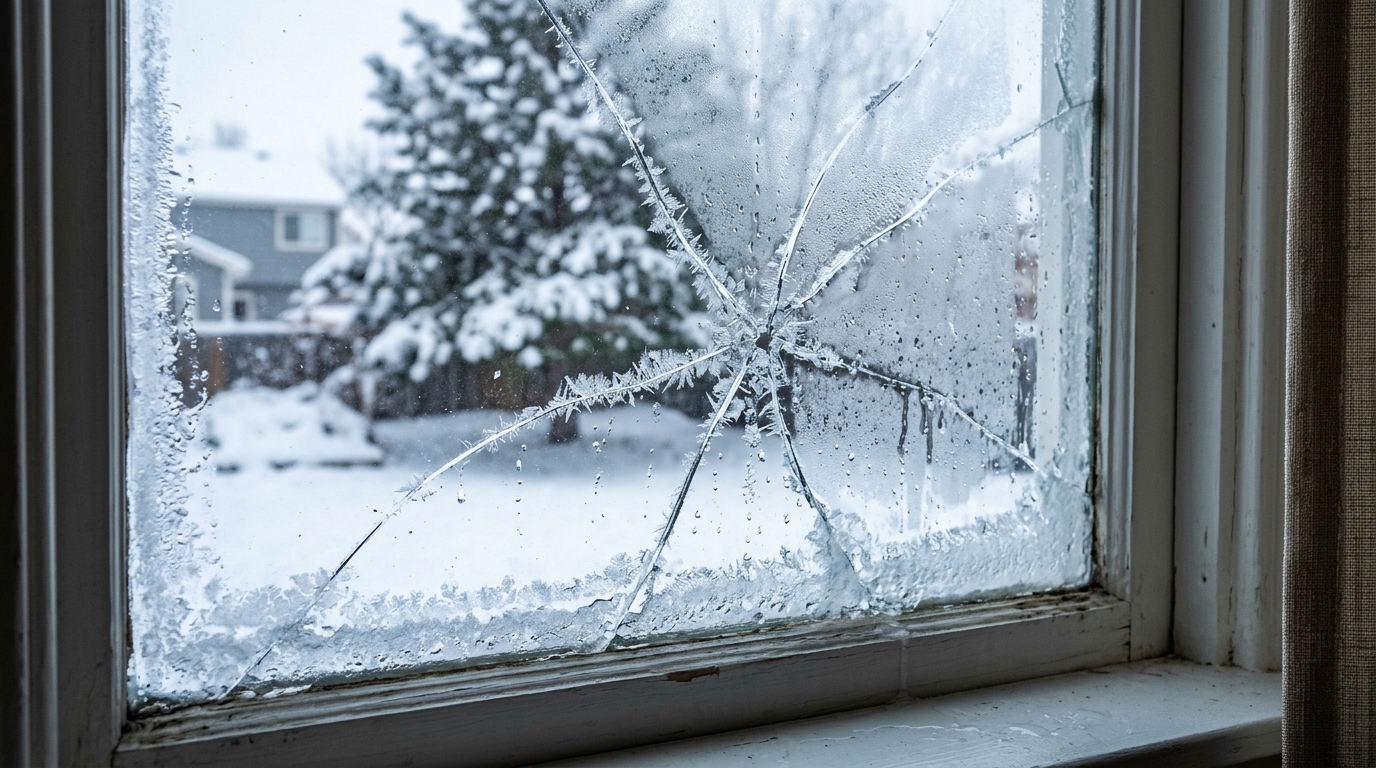
It’s a bright January afternoon in Parker. The sun is pouring through the living room window, and the glass feels almost warm to the touch. By midnight, it’s well below freezing outside.
The next morning, you notice something. That small crack in the corner of the pane, the one you spotted back in October and meant to deal with, looks longer than it did yesterday.
You’re not imagining it. Colorado’s freeze-thaw cycle is hard on window glass, and it’s especially hard on glass that is already chipped or cracked. A flaw that sat quietly all summer can start to grow once winter’s daily swings arrive.
This guide explains what is happening to that glass, which kinds of damage tend to get worse, which warning signs mean you shouldn’t wait, and why a prompt professional assessment is usually the safest next step.
What the Freeze-Thaw Cycle Looks Like on a Colorado Window
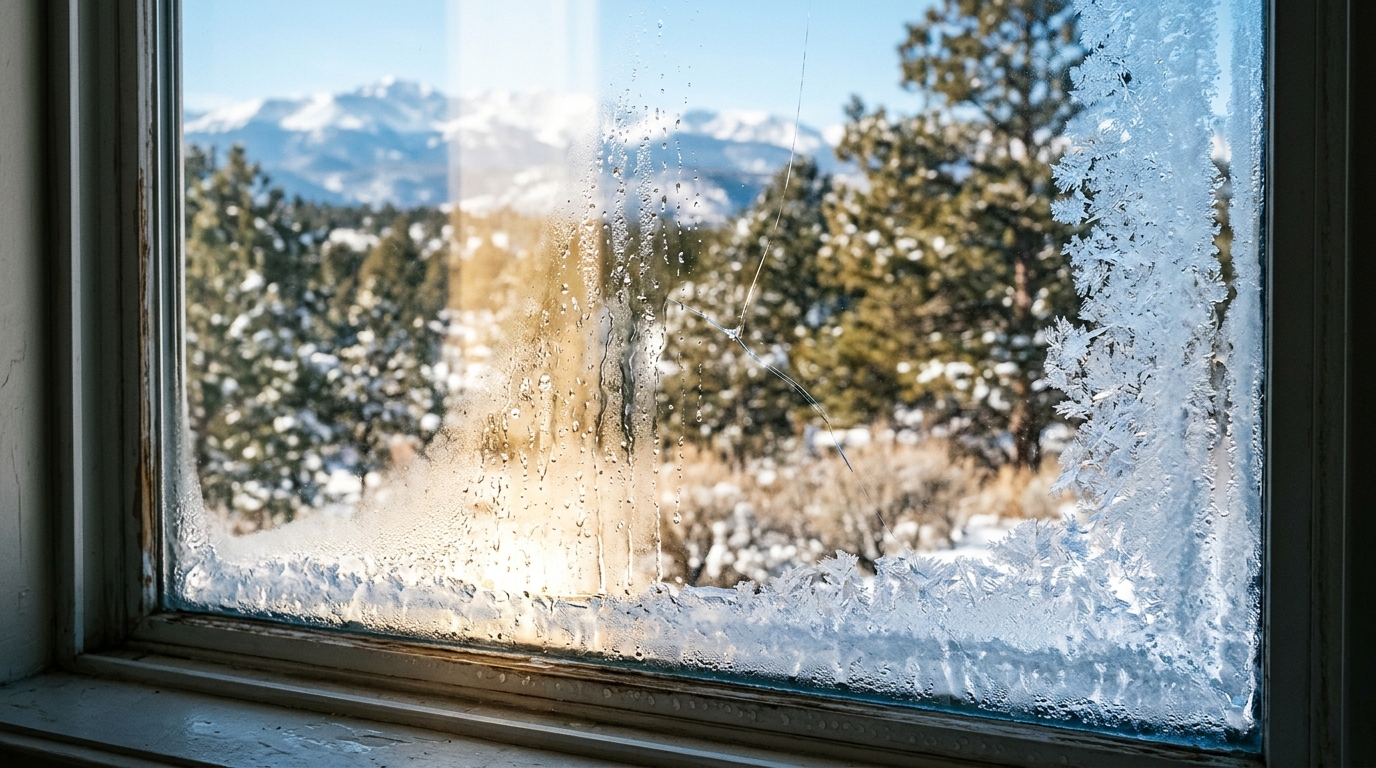
A freeze-thaw cycle is simple: temperatures drop below freezing, then climb back above it. In many places that happens a handful of times each winter. Along Colorado’s Front Range, it can happen over and over, sometimes within a single day.
Part of the reason is geography. The Front Range sits right against the mountains, in a dry, high-altitude climate. Clear skies let the sun warm surfaces quickly during the day, then let heat escape just as quickly after dark.
Wind plays a role too. According to Colorado Public Radio’s explainer on Colorado’s temperature swings, a west wind coming down off the mountains can warm Front Range towns by 30 to 40 degrees in a short time. When that wind stops or a cold front moves in, temperatures can fall just as fast.
Now picture what that means for a window:
- Morning: The glass is cold, close to the outdoor temperature on its outer face.
- Midday: Strong, high-altitude sunshine heats part of the pane, while the edges stay cooler inside the frame.
- Night: The temperature drops below freezing, and the glass cools and shrinks again.
Glass expands slightly as it warms and contracts as it cools. A healthy pane handles this movement all the time. The trouble starts when the glass already has a weak spot.
Why Damaged Glass Reacts Differently Than Healthy Glass
Undamaged glass spreads stress fairly evenly across its surface. Damaged glass doesn’t. That difference is why a crack can sit still for months and then suddenly start moving once winter arrives.
Cracks and Chips Are Stress Magnets
When glass expands and contracts, the force has to go somewhere. In a smooth pane, it spreads out. In a cracked or chipped pane, it gathers at the sharpest point, which is the tip of the crack or the edge of the chip.
Think of a small tear in a sheet of paper. Pull gently on the sheet, and the tear is where it gives way. Glass behaves in a similar way. Each cycle of warming and cooling puts a little more pressure on that weak point, and the crack can creep forward.
This is also why a crack rarely “settles down” on its own. Glass does not heal. Once a crack exists, every temperature swing is another chance for it to grow.
Sun on One Side, Shade on the Other
Colorado’s winter sun is strong. It can heat the middle of a pane while the edges, tucked inside the frame, stay much cooler. Shadows from an overhang, a tree, or a neighboring house can do the same thing across one piece of glass.
When one part of the glass is warm and another part is cold, they expand by different amounts. Professionals call this a thermal gradient, which simply means a temperature difference across the glass. That uneven pull creates thermal stress.
Indoor conditions can add to it. A heating vent blowing directly on the glass, or dark blinds that trap heat against it, can make one area much warmer than the rest. On healthy glass this may cause no harm. On glass with an existing chip or edge damage, it can be the push that starts a crack or makes one longer.
Moisture, Ice, and the Edges of a Break
An open chip or crack on the outside of a window can collect water from melting snow or rain. Water expands when it freezes, so ice in a small opening can press outward on the glass around it.
Moisture also matters around the glass, not just inside the break. If a crack reaches the edge of the pane, or the seal around the glass is damaged, water can work its way toward the frame. Over a winter of freezing and thawing, that can affect the frame and the materials around the window, not just the glass itself.
Common Types of Window Glass Damage and How Winter Affects Each
Not every crack means the same thing. The shape and location of the damage often hint at what caused it, and that affects how urgent it is. The table below is a quick guide for spotting what you’re looking at. It is not a substitute for an in-person assessment.
| Type of damage | What it usually looks like | How freeze-thaw can affect it | Why a professional look matters |
| Edge crack (thermal stress crack) | A single line that starts at the edge of the glass, often at a right angle to it, then may wander | Daily sun-and-shade swings keep stressing the edge, so the crack can lengthen | Edge cracks weaken the pane where it is held in the frame |
| Impact chip or starburst | A small pit or a star-shaped break with lines spreading from one point | Each line is a stress point; water in the chip can freeze and add pressure | Several branching lines can spread in different directions at once |
| Hairline crack in the middle of the pane | A thin crack that may not reach any edge yet | Temperature changes can push it toward the edges | Once it reaches an edge, the glass loses much more strength |
| Cracked pane in a double-pane window | A crack in one layer of an insulated glass unit (IGU), the sealed two-pane glass in most modern windows | Cold and warm cycles keep working the crack and can strain the seal | The whole sealed unit may need attention, not just one layer |
| Fogging between the panes | Cloudy or wet-looking glass you cannot wipe clean from either side | Repeated expansion and contraction keeps stressing an already failed seal | Shows the seal has failed and the unit no longer insulates as designed |
| Damaged seal or glazing at the frame | Gaps, cracking, or separation where the glass meets the frame | Water can enter, freeze, and widen the gap | Can let moisture reach the frame and wall around the window |
If your window shows more than one of these signs, such as a crack plus fogging, that is a strong reason to have it checked sooner rather than later.
Warning Signs Your Damaged Window Shouldn’t Wait
Some damage can be scheduled at a convenient time. Other damage is telling you to act soon. You don’t need to touch or test the glass to notice these signs. A careful look from a safe distance is enough.
It’s time to call a professional promptly if you notice:
- The crack is visibly longer than when you first saw it, even by a little.
- New branches are forming off the original crack or chip.
- The crack has reached the edge of the glass or the frame.
- The damage sits in direct sun or close to a heating vent, where temperature swings are strongest.
- Fogging or moisture appears between the panes of a double-pane window.
- You feel a draft or see moisture on the sill or frame near the damaged glass.
- The glass looks loose, shifts, or makes a rattling sound when the wind blows.
- The window is in a high-risk spot, such as a door, a bathroom, near the floor, or in a child’s room.
A quick photo of the damage with a date can help too. It gives you, and the professional you call, a simple way to see whether the crack is growing.
The Safety Side: When a Crack Is More Than Cosmetic
It’s easy to think of a cracked window as an eyesore you’ll get to eventually. But cracked glass is weaker glass. The bigger question is not how it looks, but how it might fail.
A cracked pane can break with much less force than an intact one. A door that slams, a strong gust, a ball, or even a quick change in temperature can be enough. In Colorado, where a mild afternoon can turn into a windy, freezing night, those triggers are common.
How the glass breaks matters too. Different types of glass fail in very different ways:
- Annealed glass, the standard glass found in many older windows, can break into large, sharp, jagged pieces.
- Tempered glass is heat-treated for strength. When it fails, it breaks into many small, blunter pieces, and it can fail all at once.
- Laminated glass has a plastic layer between two sheets. When it cracks, the layer tends to hold the pieces in place.
You often can’t tell which type you have just by looking. That’s one reason a professional assessment is so useful.
Location raises the stakes. Building codes generally call for safety glass in places where people are more likely to bump into or fall against glass. These include doors, glass near tubs and showers, and large panes close to the floor. Damage in these spots deserves quick attention, especially in homes with children or pets.
Bedroom windows that serve as emergency exits are another concern. A damaged window there should open, close, and work as intended when it matters most.
If the damage is in a door, a bathroom, a low window, or a room where kids play, it’s worth having it looked at soon. Hansen Glass can assess the glass, explain the risk in plain terms, and help determine whether prompt replacement is the safer choice.
Until then, keep people and pets away from badly cracked glass, and don’t try to remove, press on, or patch it yourself.
Why Waiting Until Spring Often Backfires
Putting off a window problem until the weather warms up feels reasonable. Who wants work done in January? The catch is that Colorado winters don’t pause the damage. They tend to speed it up.
Small damage rarely stays small. A chip near the center of a pane today can become a crack that reaches the edge after a few weeks of hard freezes and sunny afternoons. Once that happens, the options usually narrow and the fix often becomes larger.
Moisture finds the gaps. A crack that reaches the edge, or a seal that has started to fail, can let water and melting snow move toward the frame. Over a winter, repeated wetting and freezing can damage wood, finishes, and the area around the window. That turns a glass problem into a bigger home problem.
Comfort and efficiency suffer. Windows play a large part in how warm a home stays. The U.S. Department of Energy’s Energy Saver guide to energy-efficient windows explains how window condition and performance affect energy loss and comfort. A cracked pane or a failed seal in a double-pane unit can make the room nearby feel colder and draftier through the coldest months.
Safety risk builds over time. Every week a damaged pane stays in place is another week of wind, temperature swings, and daily use. As covered above, cracked glass is more likely to fail suddenly.
None of this means you should panic about every chip. It means the best time to understand what you’re dealing with is now, not after the next cold snap.
What a Professional Glass Assessment Looks At
A good assessment is more than a quick glance and a guess. A trained glass professional is reading the damage for clues about what caused it, how stable it is, and what will hold up best through the rest of the winter.
Where the damage started. A crack that begins at the edge points toward thermal stress. A starburst points toward an impact. Knowing the cause matters, because a stress crack in a sunny, shaded spot may happen again if the same conditions stay in place.
Where the damage sits. Damage close to the edge, at a corner, or running into the frame usually weakens the pane more than a small mark near the center.
What kind of glass it is. The professional will identify whether the window has annealed, tempered, or laminated glass, and whether it is a single pane or a sealed double-pane unit. This affects both the safety risk and the right replacement glass.
The condition of the seal and frame. Fogging, gaps, moisture, or movement around the glass can show that the problem goes beyond the visible crack.
The window’s surroundings. Sun exposure, shade patterns, nearby heating vents, and the window’s location in the home all help explain why the glass failed and what will work better.
Safety requirements for that spot. Glass in doors, bathrooms, and low windows may need safety glass. A professional will factor that into the recommendation.
This is exactly the kind of evaluation Hansen Glass provides for homeowners in Parker and the south Denver area. The goal is a clear explanation of what’s wrong, how urgent it is, and what the right fix looks like for that specific window.
Glass Repair or Glass Replacement? How the Decision Gets Made
Homeowners often hope a crack can simply be “fixed.” Sometimes very limited surface damage can be addressed. But window glass doesn’t heal, and a crack that is already moving through a pane usually means the glass itself needs to be replaced.
The good news is that replacing damaged glass does not always mean replacing the whole window. In many cases, the frame is still sound, and only the broken pane or the sealed double-pane unit needs to be replaced.
A professional will usually weigh a few key questions:
- Is the damage small and stable, or is it spreading?
- Does it reach the edge of the glass or the frame?
- Is it a single pane, or a sealed double-pane unit with a failed seal?
- Does the location call for safety glass?
- Is the frame around the glass still in good condition?
Because every window and home is different, the final scope depends on what the inspection finds. The type of glass, the size of the window, how easy it is to reach, and the condition of the frame all play a part. That’s why an on-site look gives a far more reliable answer than any general rule.
Winter Won’t Wait, So Your Window Shouldn’t Either
Colorado’s freeze-thaw cycle is just part of life on the Front Range. Healthy glass handles it well. Damaged glass is a different story.
Every sunny afternoon and freezing night puts fresh stress on the weakest point in a cracked or chipped pane. Over a winter, that can turn a small flaw into a spreading crack, a failed seal, or a safety hazard in a spot where people live and move every day.
The practical takeaway is simple. Notice the damage, watch for the warning signs, keep people away from badly cracked glass, and have it professionally assessed before the coldest stretch of winter does more harm.
If a crack has appeared or grown in one of your windows this season, Hansen Glass can take a look, explain what’s happening, and recommend the right glass repair or replacement for your home.
Frequently Asked Questions
Can cold weather really make a window crack spread?
Yes. Glass expands as it warms and contracts as it cools. In a cracked pane, that movement concentrates stress at the tip of the crack, so repeated swings can push it further. Colorado’s sunny days and freezing nights create many of these swings each winter.
Why did my window crack when nothing hit it?
A crack with no impact point is often a thermal stress crack. It forms when one part of the glass gets much warmer or colder than another, such as a sunny center and a cold edge. These cracks usually start at the edge of the glass rather than in the middle.
Is fogging between the panes connected to freeze-thaw damage?
It can be. Fogging between the panes means the seal on a double-pane unit has failed and moisture has gotten inside. Repeated heating and cooling puts ongoing stress on that seal. Once it fails, the unit can’t be wiped clean and no longer insulates as designed.
Is it okay to leave a small chip or crack until spring?
Sometimes, but it’s risky in a Colorado winter. A small chip in direct sun, near an edge, or near a heat source can grow quickly. Damage in doors, bathrooms, or low windows should not wait. A professional assessment is the best way to know whether yours is stable.
How soon should I have a cracked window assessed?
As soon as you can, ideally before the next stretch of hard freezes. Get it looked at right away if the crack is growing, has reached the edge, shows fogging, or is in a spot where safety glass matters.