
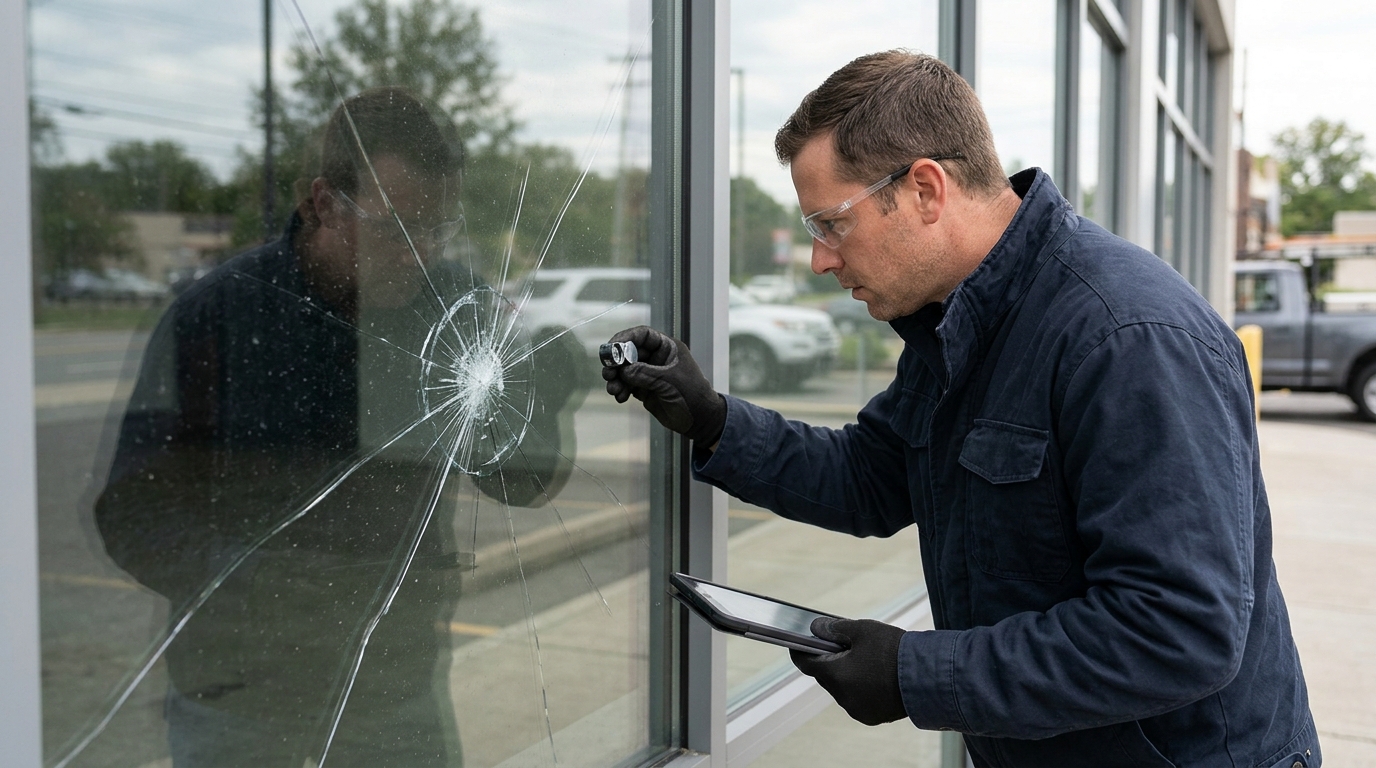
You hear a thud against the window. Maybe it was a branch in a storm, a stray ball in the yard, or something you never actually saw. When you check the glass, there is a small crack, or maybe just a chip. It does not look like much.
But is it actually fine?
That question is harder to answer than it seems. Glass does not always show the full extent of its damage on the surface. What looks like a minor mark can be sitting on top of a much bigger structural problem, and what looks alarming can sometimes be only cosmetic. This is exactly why glass professionals do not judge damage by a quick glance. They follow a process, one built around understanding how glass actually fails.
This guide walks through how that assessment works, what professionals are really looking for, and how you can tell when a piece of damaged glass needs more than a passing glance.
Why Impact Damage Isn’t Always What It Looks Like
Glass is a rigid material, but it is not a simple one. When something strikes it, the force does not stay in one spot. It moves outward from the point of contact, following the internal stress patterns already present in the glass.
That means a small chip on the surface can hide a stress fracture that has already spread further than you can see. In some cases, the glass may look stable for days or even weeks before it finally gives way. Temperature swings, wind pressure, or something as simple as closing a door nearby can be enough to finish what the original impact started.
This delayed failure is one of the main reasons homeowners get caught off guard. The glass was already compromised. It just had not shown it yet.
What “Structurally Compromised” Actually Means
It helps to separate two very different categories of damage.
Cosmetic damage affects only the surface. Think light scratches, small surface pits, or shallow chips that do not run into the body of the glass. This kind of damage does not reduce the glass’s ability to hold together or resist pressure.
Structural damage is different. This is damage that has changed how the glass distributes stress, whether that is a crack running through the pane, a chip that has reached the edge, or an impact point where the glass has crushed or fractured beneath the surface. Once glass reaches this point, it is no longer performing the way it was designed to.
The tricky part is that these two categories can look similar to an untrained eye. That is where a professional assessment earns its value.
How Glass Professionals Read an Impact
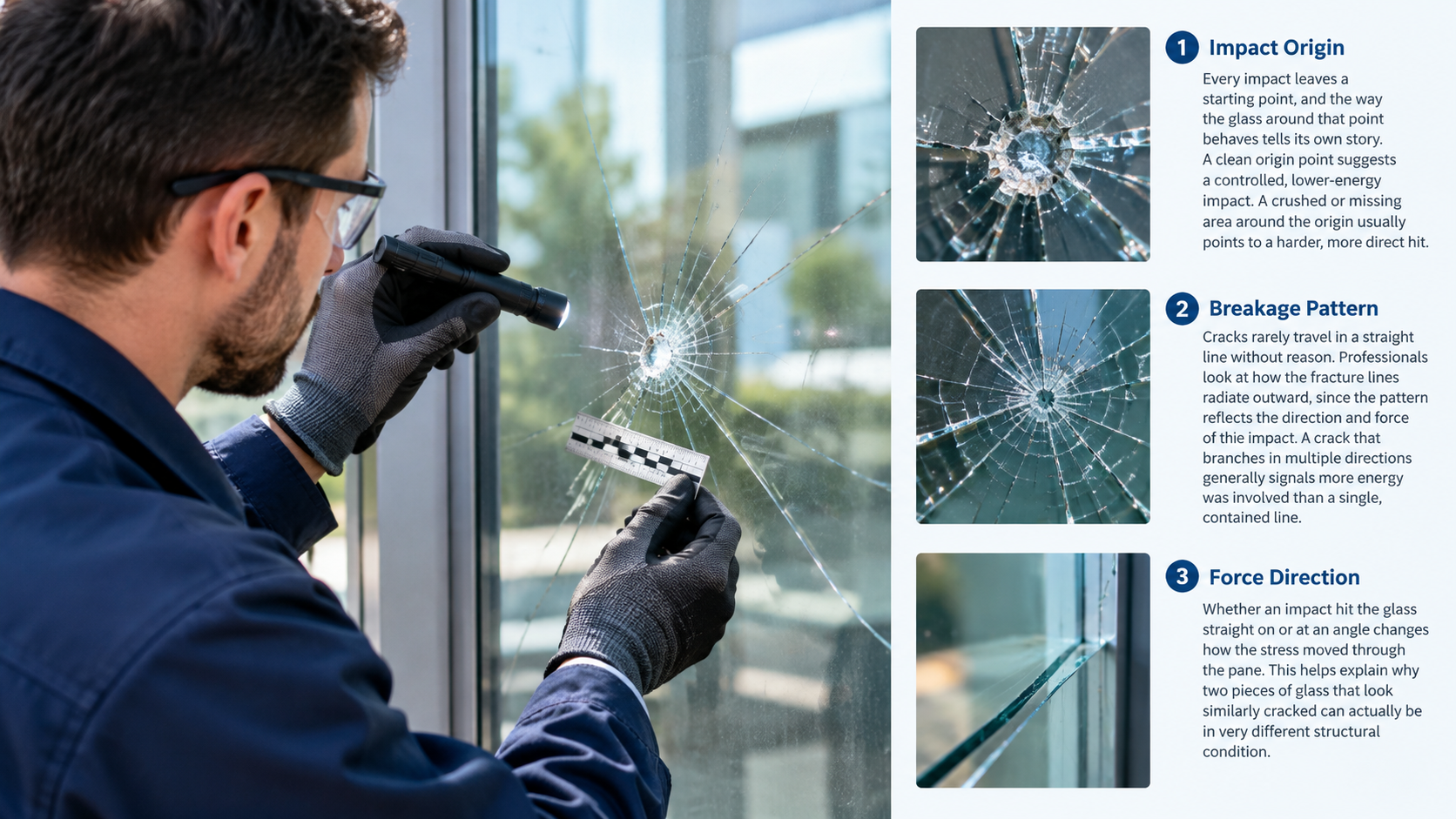
When a technician looks at damaged glass, they are not just checking whether it is broken. They are trying to understand what happened and how the glass responded to it. A few factors guide that process.
Impact origin. Every impact leaves a starting point, and the way the glass around that point behaves tells its own story. A clean origin point suggests a controlled, lower-energy impact. A crushed or missing area around the origin usually points to a harder, more direct hit.
Breakage pattern. Cracks rarely travel in a straight line without reason. Professionals look at how the fracture lines radiate outward, since the pattern reflects the direction and force of the impact. A crack that branches in multiple directions generally signals more energy was involved than a single, contained line.
Force direction. Whether an impact hit the glass straight on or at an angle changes how the stress moved through the pane. This helps explain why two pieces of glass that look similarly cracked can actually be in very different structural condition.
The Role of Edges and Corners
Edges and corners are the weakest points in almost any pane of glass. A chip or crack that starts near an edge is far more concerning than one in the center of the pane, because the edge is where the glass has the least reinforcement to resist spreading stress. This is why professionals pay close attention to how close damage sits to an edge or corner, even when the damage itself looks small.
Why Glass Type Changes the Assessment
Not all glass fails the same way, so the assessment changes depending on what type of glass is involved.
Tempered glass is designed to break into small, rounded pieces rather than large shards, which is a safety feature. But that also means tempered glass can shatter suddenly, sometimes without warning, once it has been compromised.
Laminated glass tends to hold together even after cracking, since the interlayer keeps the fragments in place. That can make damage harder to spot at first glance, because the pane may still look intact even though it has lost integrity.
Insulated glass units, the double-pane systems common in most homes, add another layer. Damage to one pane can affect the seal between the layers, which is a separate issue from the structural strength of the glass itself.
Warning Signs That Point to a Real Problem
While only a professional inspection can confirm the full picture, there are signs that should prompt a closer look sooner rather than later:
- A crack that has grown longer since you first noticed it
- Cracks that branch into multiple directions from one point
- Any chip or crack that reaches the edge of the pane
- Glass that feels loose, or fragments that shift when touched
- Fogging or moisture appearing between the panes of a double-pane window
- Damage located near a door, low to the ground, or in another high-traffic spot
- Glass that was struck hard, even if it still looks intact afterward
If you notice more than one of these signs at once, it is a stronger indicator that the damage goes beyond the surface.
Comparing Damage Types at a Glance
| Damage Type | What It Typically Looks Like | Why It Matters |
| Surface scratch | Shallow mark, does not catch a fingernail | Usually cosmetic, low priority |
| Small chip (away from edge) | Minor surface loss, contained shape | Often stable, but worth monitoring |
| Edge or corner chip | Damage close to or touching the pane’s border | Higher risk of spreading due to lower edge strength |
| Single hairline crack | Thin line, has not visibly grown | Should be evaluated, especially in cold or hot weather swings |
| Branching or spreading crack | Multiple crack lines from one origin point | Signals real structural compromise |
| Impact point with crushed area | Glass appears pushed in or missing at the strike point | Strong indicator of a hard, direct impact |
| Foggy insulated glass after impact | Moisture or haze between panes | Seal failure, separate from but often linked to structural damage |
This table is meant as a general guide, not a diagnosis. The same visible damage can mean different things depending on the glass type, its age, and how it is installed.
What Happens During a Professional Assessment
A proper assessment goes beyond a visual check. A technician will examine the impact point, trace the breakage pattern, check how close the damage sits to an edge, and take the glass type and installation into account before reaching a conclusion. Frame condition matters too, since a sound piece of glass sitting in a damaged frame is still a problem.
This is the kind of evaluation Hansen Glass performs when assessing impact damage. Rather than guessing from a photo or a quick look, the goal is to understand exactly what the glass has been through and what that means for its current condition, so the homeowner gets a clear answer instead of an assumption.
When to Stop Waiting and Call a Professional
Some damage can reasonably wait for a convenient time. Other damage cannot. If a crack is actively growing, if fragments feel loose, if the damage sits near an edge, or if you are simply unsure what you are looking at, it is worth having it looked at sooner rather than later. Waiting on structurally compromised glass does not make the problem smaller. It usually just adds time for the damage to progress.
This is where reaching out to Hansen Glass makes sense as a next step. Getting a clear, professional read on the damage removes the guesswork and gives you a straightforward path forward, whether that means monitoring, repair, or replacement.
According to the National Fenestration Rating Council, fenestration products, including glazing, are expected to perform to certain standards throughout their service life, which is part of why a compromised pane should not simply be left in place once its integrity is in question. The Building America Solution Center, a resource maintained with U.S. Department of Energy support, also notes that different glass types respond very differently to stress and impact, which is part of why professional assessment accounts for glass type rather than treating all damage the same way.
Why Proper Assessment Matters
An accurate assessment protects more than the glass itself. It protects the people around it, the performance of the window or door system, and the long-term condition of the surrounding frame and seals. Treating every crack the same way, whether by ignoring it or overreacting to it, misses the point. The value of a proper assessment is that it replaces guesswork with an actual understanding of what the glass can and cannot still do.
If you are looking at damaged glass right now and are not sure what you are dealing with, Hansen Glass can assess the situation and help you understand whether it is something to monitor or something that needs a professional solution.
Conclusion
Broken or damaged glass rarely tells its whole story on the surface. A hairline crack can be nothing, or it can be the early sign of a pane that has already lost its structural integrity. The difference comes down to where the damage sits, how it formed, and what kind of glass is involved, all things a trained eye is far better equipped to judge than a quick glance from across the room.
If you are dealing with impact damage and want a clear answer instead of a guess, a professional assessment is the simplest way to get one.
Frequently Asked Questions
Can broken glass look fine but still be structurally compromised? Yes. Stress from an impact can travel through the glass without producing a visible crack right away. This is one of the main reasons professionals assess the impact point and surrounding area rather than relying on appearance alone.
Does a small chip always mean the glass needs to be replaced? Not necessarily. A small chip away from the edge is often stable, while a chip near an edge or corner carries more risk. The right call depends on location, glass type, and how the damage behaves over time.
Why does a crack near the edge matter more than one in the middle of the pane? Edges and corners have less reinforcement than the center of a pane, so cracks starting there are more likely to spread under normal stress like temperature changes or building movement.
Is tempered glass safer after an impact than other types? Tempered glass is designed to break into smaller, rounded pieces for safety, but that does not mean it is stable once compromised. It can still shatter suddenly after sustaining damage, so it should be assessed just as carefully as other glass types.
How can I tell if I need a professional assessment right away? If a crack is growing, if fragments feel loose, if damage sits near an edge, or if the glass was struck hard even without visible damage, it is worth having it evaluated promptly rather than waiting.