

You’re walking the property on a routine check when something catches your eye. A hallway window has gone hazy, like it’s fogged from the inside. Or maybe it’s a hairline crack creeping across a storefront pane near the main entrance. It doesn’t look like an emergency. It’s tempting to make a mental note and move on.
But commercial glass rarely stays a small problem for long. What looks like a cosmetic issue today can turn into a safety hazard, a tenant complaint, or a much bigger repair tomorrow. For property managers, knowing how to read these warning signs and understanding what a proper professional repair actually involves makes the difference between a quick, contained fix and a drawn-out headache.
This guide walks through why commercial glass damage deserves attention, what typically causes it, the signs worth watching for, and what happens when a qualified professional steps in to assess and repair it.
Why Commercial Glass Damage Is Worth Taking Seriously
Glass isn’t just a design feature in a commercial building. It’s a functional part of the structure that affects safety, security, comfort, and how the property is perceived by tenants and visitors.
Damaged glass can compromise a building’s protection against weather, reduce energy efficiency, and in some cases create real injury risk if a weakened pane fails without warning. It can also affect security, since a compromised window or door is easier to force open or breach than an intact one. Commercial glazing in the U.S. is also subject to federal safety glazing standards that govern where certain types of glass are required, which is part of why professional evaluation matters when damage occurs. You can review the federal safety standard for architectural glazing materials for more detail on how these requirements are structured.
There’s also the day-to-day impact on the people who use the building. A cracked storefront window or a stuck glass door creates an unprofessional impression fast, even when everything else about the property is well maintained. For property managers, glass condition is part of the broader picture of maintaining a safe, functional, and presentable building, not a separate, lower-priority item.
It’s also worth remembering that glass damage rarely stays contained to just the pane. A crack that spreads, a seal that keeps failing, or a door that gets harder to close each week can gradually put stress on the surrounding frame, hardware, and even nearby building materials. What starts as one small repair can turn into a larger project if the underlying cause isn’t identified early. That’s part of why “wait and see” tends to be the more expensive path in the long run, even when the damage looks minor at first.
Common Causes of Commercial Window Glass Damage
Glass damage doesn’t always come from one obvious event. Sometimes it’s sudden, and sometimes it develops slowly enough that nobody notices until the problem is already serious.
Here’s a quick breakdown of the most common causes property managers run into:
| Cause | What It Looks Like | Why It Happens |
| Impact damage | Chips, cracks, or shattered panes | Accidental contact, moving equipment, storm debris, or vandalism |
| Seal failure | Fogging or moisture between panes | The seal in an insulated glass unit breaks down over time, letting moisture in |
| Thermal stress | Cracks that appear with no clear cause | Rapid temperature changes put pressure on glass, especially if there’s already a weak point |
| Building movement | Cracks near corners or edges, frame misalignment | Normal structural settling or shifting places stress on glass systems over time |
| Hardware wear | Doors that stick, drag, or don’t latch | Repeated daily use loosens hinges, closers, and pivots, which then puts uneven pressure on the glass |
Understanding the likely cause matters because it shapes what the repair actually needs to address. A cracked pane caused by impact is a different situation than one caused by a failing seal or a misaligned frame, and a professional assessment is what identifies which one you’re dealing with.
It’s also worth noting that more than one cause can be at play at once. A door that’s been slamming for months due to a worn closer, for example, may eventually crack the glass it holds, meaning the visible damage is really a symptom of a hardware problem rather than the root issue itself. Treating only the symptom in cases like this is one of the more common reasons a “fixed” window or door ends up damaged again not long after.
Warning Signs Property Managers Should Never Ignore
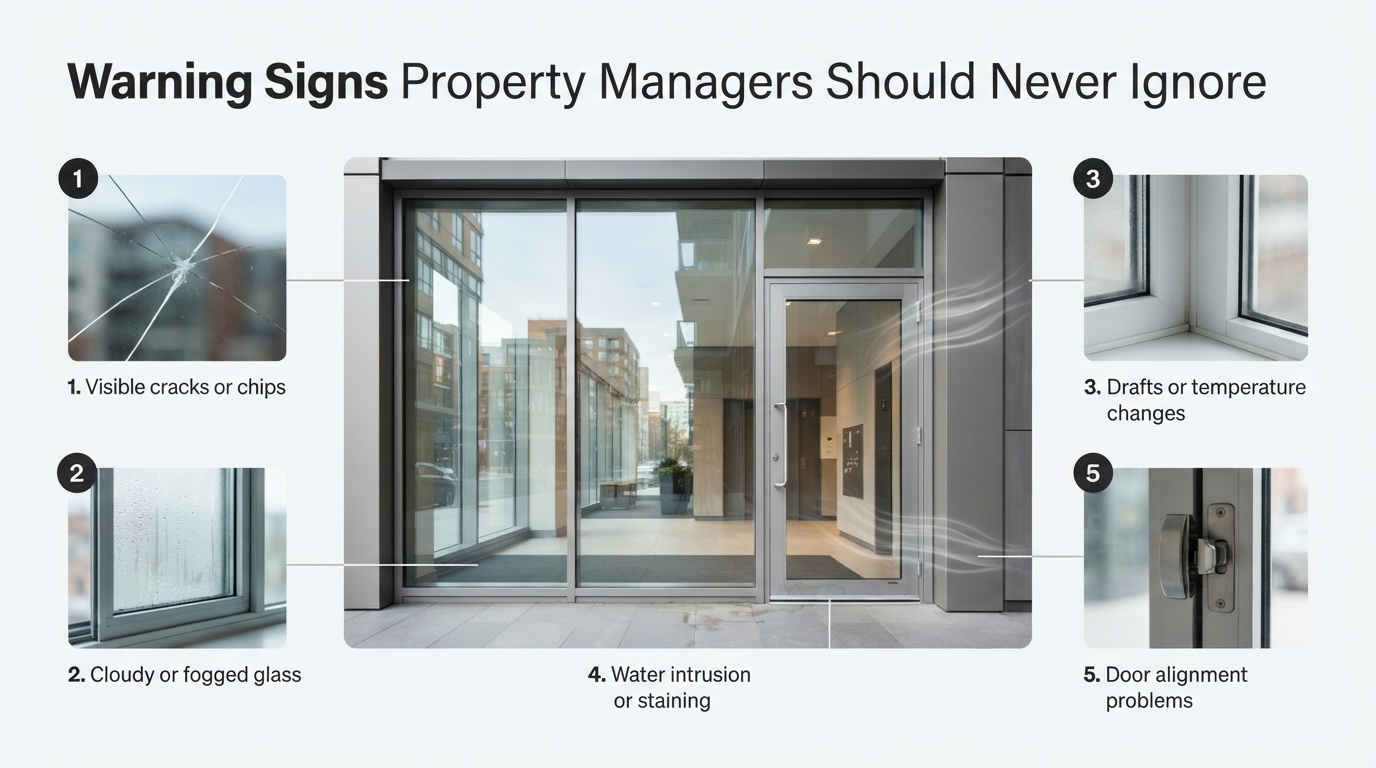
Not every glass issue looks urgent at first glance. Some of the most important warning signs are easy to dismiss as minor. Keep an eye out for:
- Visible cracks or chips, even small ones, since they tend to spread with vibration, temperature swings, or additional impact
- Cloudy or fogged glass, which usually points to a failed seal in an insulated glass unit
- Drafts or noticeable temperature changes near a window, suggesting reduced insulation performance
- Water intrusion or staining around a window frame, which can damage surrounding materials if left unaddressed
- Doors that stick, drag, or don’t close and latch properly, which often signals hardware or alignment problems that will eventually stress the glass itself
None of these signs mean you need to handle the repair yourself. What they mean is that it’s time to get a professional set of eyes on the problem before it becomes bigger, more disruptive, or more expensive to correct.
What Happens During a Professional Glass Assessment
One of the most useful things a property manager can understand is that a proper assessment looks at more than the visible crack or foggy pane. A thorough professional evaluation typically covers:
The glass itself. A technician identifies the type of glass involved (standard, tempered, laminated, or part of an insulated unit) along with its thickness and condition. This matters because different types of safety glass behave differently when damaged, and that affects what kind of repair is appropriate.
The surrounding frame. An impact strong enough to damage the glass can also affect the frame around it. Bent sections, loose glazing stops, or damaged seals are easy to miss if the inspection only focuses on the pane itself.
Hardware and alignment. For glass doors especially, hinges, closers, pivots, and locks all play a role in how much stress the glass is under day to day. If hardware is worn or misaligned, replacing the glass alone won’t solve the underlying issue.
This is exactly the kind of assessment where professional experience matters. If you’re dealing with visible damage on your property, Hansen Glass can evaluate the full window or door system, not just the glass, to help determine what’s actually going on and what the right next step looks like.
Repair or Replacement: How Professionals Decide
Not every damaged pane needs to be replaced, but not every issue can be repaired either. Professionals generally weigh a few factors when making that call.
Minor surface damage, small chips, or a failing seal on an otherwise intact insulated unit may sometimes be addressed without full replacement, depending on the specifics of the glass and its condition. On the other hand, once safety glass has structurally failed, replacement is typically the only option. Tempered glass, for example, is designed to break apart across the whole pane once its structure is compromised, which means a partial patch isn’t realistic.
Laminated glass behaves differently. Because it has a layer bonded between two panes, it can sometimes remain in place even after cracking. Still, significant damage to laminated glass usually calls for replacement to restore full performance.
Insulated glass units bring their own considerations. If the seal between the panes has failed and moisture is visible, replacing the sealed unit is usually the more effective long-term fix rather than trying to address only the surface.
Because these decisions depend on glass type, extent of damage, and how the surrounding system is holding up, this is another area where a professional inspection carries real value. Guessing at the right fix, or assuming a repair will hold when replacement is really needed, tends to create repeat problems down the line.
The Professional Repair Process, Step by Step
Understanding the general shape of a professional repair helps property managers know what to expect and recognize a thorough job when they see one.
- Initial assessment. The technician examines the damage, identifies the glass type and framing system, and determines the likely cause.
- Securing the area, if needed. If the damage compromises security or weather protection, temporary measures may be used to protect the opening until permanent work can be completed.
- Material matching. The replacement glass or repair materials are matched for thickness, type, and any coatings or ratings needed to meet the building’s safety and performance requirements.
- Removal and preparation. Damaged glass is carefully removed, and the frame is cleaned and prepared so the new material sits correctly.
- Installation and sealing. The glass is set using techniques appropriate for commercial applications, with proper sealing to protect against drafts and water intrusion.
- Final inspection. Before the work is considered complete, the technician checks alignment, sealing, and, for doors, smooth operation.
A repair that skips steps, like reinstalling glass without checking the frame or hardware, tends to leave the underlying issue in place. That’s often why the same window or door ends up causing problems again a few months later.
It’s also useful to know that not every repair follows this exact sequence in the same order. An emergency situation, such as a broken exterior pane, may call for a temporary securing step before a full assessment can happen, simply because protecting the building comes first. A slower-developing issue, like a fogging insulated unit, may go straight from assessment to scheduled replacement without needing any temporary measures at all. A good professional will explain which sequence applies to your specific situation and why.
Why Proper Assessment Matters for Property Managers Specifically
Property managers deal with a different set of pressures than a single business owner handling one storefront. You’re often coordinating repairs across multiple tenants, units, or common areas, all while trying to minimize disruption to people who live or work in the building.
A proper assessment supports that in a few concrete ways. It gives you an accurate picture of what’s actually wrong, so you’re not scheduling repeat visits for a problem that wasn’t fully diagnosed the first time. It creates a record you can point to if a tenant asks about the timeline or an insurer asks about the cause of damage. And it helps you plan the work around your building’s schedule, rather than reacting to the same issue again a few weeks later because the root cause wasn’t addressed.
There’s also a communication benefit that’s easy to overlook. When tenants notice damaged glass, they usually want to know two things: is it safe, and when will it be fixed. A clear professional assessment gives you real answers to both questions, rather than a guess. That makes it much easier to set accurate expectations, whether you’re sending a quick notice to a single tenant or coordinating around a shared common area that affects several units at once.
This is also where Hansen Glass can help simplify the process, providing a clear read on whether a section needs repair or full replacement so you can plan the work with confidence instead of guessing.
When to Call a Professional
As a general rule, it’s time to bring in a professional as soon as you notice any of the warning signs covered earlier: cracks, fogging, drafts, water intrusion, or hardware and alignment issues. You don’t need to diagnose the exact cause yourself before making the call. Describing what you’re seeing, when it started, and where it’s located gives a professional enough to begin the assessment.
If the damage affects security, such as a broken exterior pane, treat it as more urgent and restrict access to the area until it’s addressed. For less severe issues, like a slowly developing fog pattern in an insulated unit, there’s usually more flexibility to schedule the assessment at a convenient time, but it’s still worth acting before the issue worsens.
If your team or maintenance staff will be anywhere near broken glass while waiting for a professional to arrive, basic protective precautions matter. OSHA’s general requirements for personal protective equipment outline the standard for safely managing hazards like this in a workplace setting.
Conclusion
Commercial window glass damage is easy to underestimate. A small crack or a hazy pane doesn’t always look urgent, but left alone, these issues tend to grow into safety risks, tenant complaints, or more disruptive repairs. Property managers who understand what causes glass damage, recognize the warning signs early, and know what a thorough professional process looks like are in a much stronger position to protect their buildings and the people in them.
When damage does show up, a proper assessment, one that looks at the glass, the frame, and the hardware together, is what leads to a repair that actually holds. If you’re noticing signs of glass damage on your property, reaching out to Hansen Glass is a practical next step toward getting a clear, professional read on the situation.
Frequently Asked Questions
How urgent is a cracked commercial window? It depends on the severity and location. A small crack away from high-traffic areas may not require same-day attention, but it should still be assessed soon, since cracks tend to spread with vibration or temperature changes. A crack near an entrance, in a security-sensitive area, or in glass that’s clearly compromised should be treated as more urgent.
How do I know if my glass needs repair or replacement? That depends on the type of glass, the extent of the damage, and whether the seal or structure has failed. This is exactly what a professional assessment is designed to determine, since guessing can lead to a fix that doesn’t actually resolve the underlying issue.
What should I expect during a professional glass assessment? A technician will typically examine the glass itself, the surrounding frame, and any related hardware like hinges or closers. They’ll identify the glass type, likely cause of damage, and recommend whether repair or replacement is the right path forward.
How can I reduce the chances of repeat glass damage? Regular visual checks help catch small issues, like loose gaskets or minor cracks, before they become larger problems. Encouraging staff or on-site personnel to report unusual door movement or new damage early also helps you respond before an issue escalates.
What information should I have ready before contacting a professional? It helps to know roughly when the damage was noticed, where it’s located, whether it affects a window or a door, and any relevant details like whether the area needs to be secured. Photos of the damage are also useful if you’re able to take them safely.