
You’re walking past the living room window and you notice it: a thin line running across the glass. Maybe it’s been there a week. Maybe you just spotted it today. Either way, your first thought is probably the same one most homeowners have.
It’s just a crack. It still looks fine. I’ll deal with it eventually.
That instinct makes sense. A cracked window doesn’t look like an emergency. It doesn’t smoke, leak, or make noise. But glass doesn’t fail the way most household materials do. A crack in a window isn’t just a mark on the surface, it’s a sign that the glass has already lost some of its strength, and that loss doesn’t reverse itself. Understanding what’s actually happening inside that crack is the first step to knowing whether you’re looking at a minor cosmetic flaw or a real safety concern.
A Cracked Window Is Rarely “Just” a Cosmetic Problem
Glass is strong until it isn’t. Unlike wood or metal, glass doesn’t bend or flex to absorb stress, it holds firm until it suddenly gives way. Once a crack forms, the glass around it is under more strain than before, even if nothing about the crack looks different from one day to the next.
That’s the part that trips people up. A hairline crack can sit quietly for weeks, then widen after a cold night, a slammed door down the hall, or nothing you’d notice at all. The visible damage rarely tells the whole story about what’s happening at a structural level.
This doesn’t mean every crack is a five-alarm emergency. But it does mean that “it still looks okay” isn’t a reliable way to judge whether a window is still doing its job safely.
What Actually Causes Window Glass to Crack
Most cracks trace back to one of a few common causes. Knowing which one applies to your window can help you understand how urgent the situation might be.
Temperature Swings and Thermal Stress
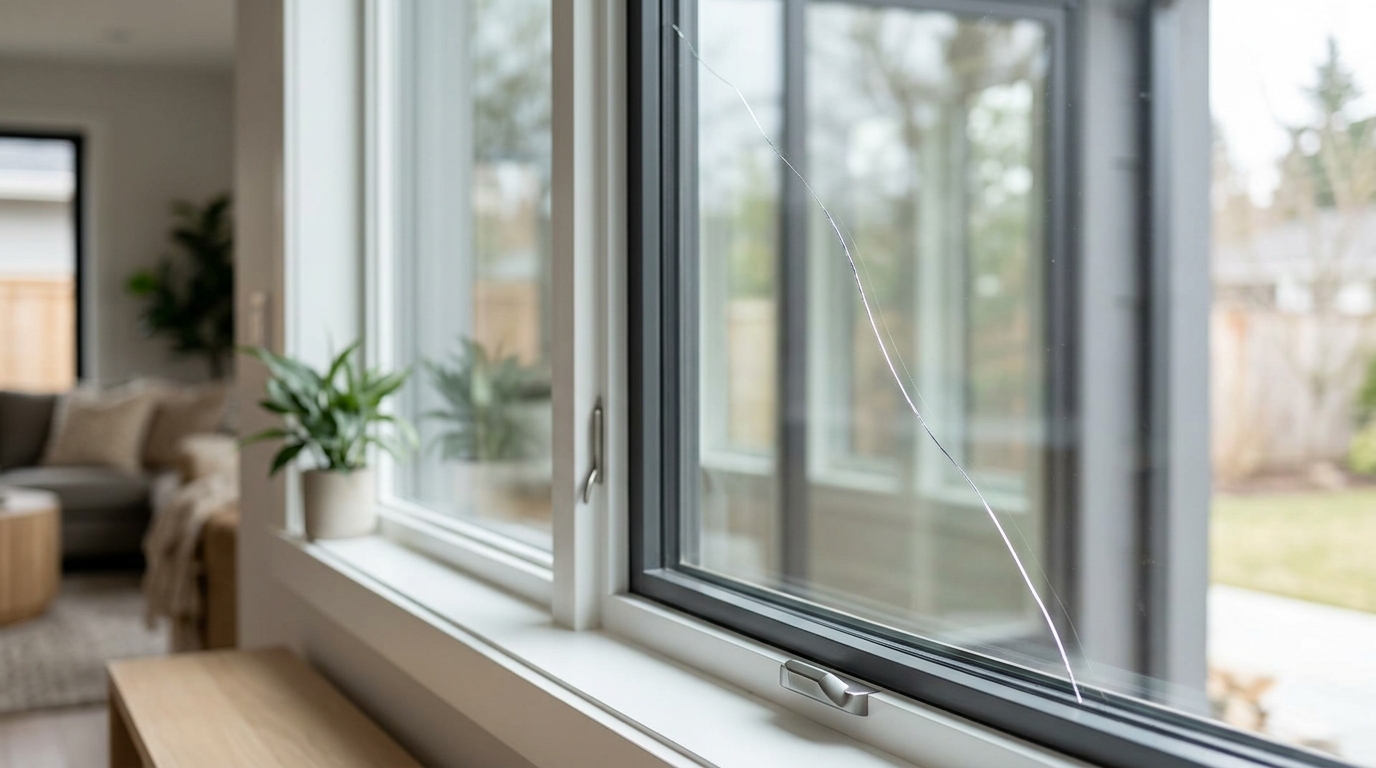
Glass expands when it warms and contracts when it cools. When one part of a pane heats up faster than the rest (say, direct afternoon sun hitting one corner while the rest stays shaded), the uneven expansion creates internal stress. If that stress exceeds what the glass can absorb, a thermal crack forms, usually starting near an edge and running inward at a sharp angle.
Impact Damage
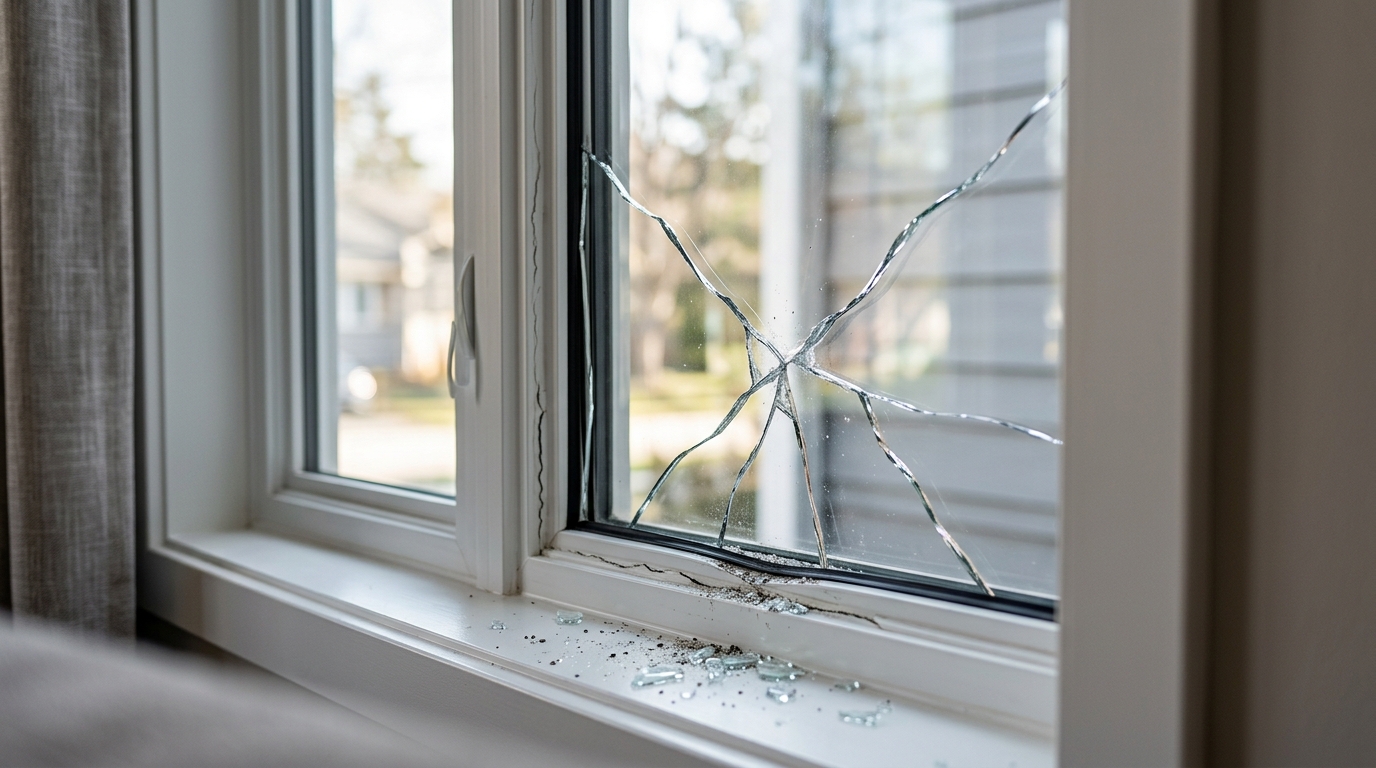
This is the most recognizable cause. A thrown object, storm debris, or an accidental bump creates a crack that radiates outward from the point of contact, often in a starburst or spiderweb pattern. The seriousness depends on how hard the impact was and where it landed on the pane.
Pressure and Installation-Related Stress
Insulated glass units, the double or triple-pane windows common in most homes, can develop cracks when the pressure between the panes doesn’t match the outside environment properly, or when a window wasn’t installed with enough room for the glass to expand and contract naturally. These cracks often look different from impact damage: smoother, curved, without an obvious point of origin.
The table below summarizes how these causes typically show up and how seriously they should be taken.
| Crack Type | Typical Cause | General Risk Level |
| Thermal crack | Uneven heating/cooling, sun exposure | Moderate, often progresses slowly but should be evaluated |
| Impact crack | Direct force from an object or debris | High, can spread quickly, especially with hard impacts |
| Pressure/installation crack | Improper installation, sealed-unit pressure imbalance | High, may affect the seal and long-term stability |
| Edge or corner crack | Frame stress, rigid installation, minor prior damage | Variable, depends on surrounding conditions |
No matter the cause, the underlying point is the same: a crack represents a change in the glass’s structural condition, not just its appearance.
How a Small Crack Turns Into a Real Hazard
Cracks don’t need a dramatic event to get worse. Ordinary daily life puts small amounts of stress on window glass constantly: a door closing elsewhere in the house, foot traffic near the window, temperature changes between morning and afternoon. None of that would matter to intact glass. But once a crack exists, it becomes a weak point that concentrates stress instead of spreading it evenly.
Over time, this can cause the crack to lengthen, branch, or eventually reach a point where the glass loses its ability to hold together. When that happens, a window that looked stable can shatter with very little warning, sending glass fragments into a room where people are sitting, walking, or sleeping nearby.
This is why a crack that seems unchanged for weeks can still be a legitimate concern. The absence of visible progress doesn’t mean the glass isn’t weakening. It often just means the failure point hasn’t been reached yet.
Warning Signs That Signal a Bigger Problem
Not every crack needs immediate attention, but certain signs suggest the situation deserves a closer look sooner rather than later:
- The crack is visibly getting longer, wider, or branching into new lines
- You notice fogging or condensation trapped between the panes
- The window feels drafty or lets in noticeably more outside air
- The glass rattles or shifts slightly when the window is opened or closed
- The window has become difficult to open, close, or latch properly
- The crack sits near a corner or edge, where structural stress concentrates
If you’re seeing one or more of these signs, it’s a reasonable point to stop monitoring the window on your own and bring in a professional opinion.
Beyond Safety: Security and Energy Efficiency Consequences
A cracked window’s problems don’t stop at the risk of shattering glass. Windows are one of the more common points of entry into a home, and a compromised pane is inherently weaker against forced entry than intact glass, something worth factoring in if the crack is on a ground-floor or easily accessible window.
There’s also an efficiency cost. If the crack has affected the seal on an insulated unit, you may notice drafts, temperature swings near the window, or a harder-working HVAC system. Moisture can also find its way into small gaps over time, which can lead to further deterioration of the frame or surrounding materials if it goes unaddressed long enough.
In other words, a cracked window rarely affects just one thing. Safety, security, and efficiency tend to move together. When one is compromised, the others usually aren’t far behind.
Why Professional Assessment Matters, Not Guesswork
It’s tempting to look at a crack, decide it seems “not that bad,” and move on. But there’s a real difference between a visual guess and an actual assessment. A professional evaluation considers factors a homeowner typically can’t judge from the outside: the type of glass, how the crack originated, whether the seal has been compromised, and how the surrounding frame is holding up.
This matters because two cracks that look almost identical can represent very different levels of risk depending on where they started and how the glass around them is behaving. If you’re dealing with a crack and aren’t sure what it means for your home, Hansen Glass can assess the situation and help determine the right next step, whether that means monitoring it, repairing it, or replacing the pane entirely.
What a Professional Evaluation Actually Looks At
A proper assessment isn’t just a glance at the crack itself. It typically involves looking at:
- Where the crack originated: near an edge, a corner, or the center of the pane, since each suggests a different underlying cause
- The type and age of the glass: tempered, laminated, or standard annealed glass all behave differently once damaged
- The condition of the seal, especially for double or triple-pane windows, since seal failure affects both safety and efficiency
- The surrounding frame, to check whether structural stress from the frame itself contributed to the crack
This is the kind of detail that separates an informed decision from a guess. A team like Hansen Glass can walk through these factors during an assessment, giving you a clearer picture of whether the window is stable for now or needs more immediate attention.
According to safety glazing standards maintained by the American National Standards Institute, architectural glazing materials are tested specifically to reduce injury risk when glass breaks, a reminder that not all glass responds to damage the same way, and that professional insight into glass type and condition genuinely matters. The U.S. Consumer Product Safety Commission also maintains federal safety requirements for architectural glazing, underscoring just how seriously glass condition is treated from a safety standpoint.
When to Stop Waiting and Get It Looked At
If your window shows any of the warning signs mentioned earlier (a spreading crack, fogging, drafts, or a corner-originating fracture), it’s worth treating that as your cue to move from “keeping an eye on it” to “having it looked at.” You don’t need to panic over every hairline mark on a windowpane, but you also don’t need to wait for a dramatic failure to justify getting a second opinion.
If you’re unsure where your situation falls, reaching out to Hansen Glass for an assessment is a reasonable, low-pressure way to get clarity, rather than relying on how the crack happens to look on any given day.
Conclusion
A cracked window is easy to dismiss because it doesn’t announce itself the way other home problems do. But glass damage works differently than most wear and tear: what looks unchanged on the surface can still be losing structural integrity underneath. Recognizing the difference between a cosmetic mark and a genuine safety concern isn’t about assuming the worst. It’s about understanding what’s actually happening in the glass, watching for the signs that matter, and knowing when it’s time for a professional to take a closer look. Treating a crack seriously early on is almost always simpler than dealing with the consequences of ignoring it.
Frequently Asked Questions
Is a small crack in a window really dangerous? It can be. Size alone doesn’t determine risk, where the crack started and how the glass is behaving matter more. A small crack near an edge or corner can sometimes be more concerning than a longer crack elsewhere on the pane.
Can a cracked window get worse even if I don’t touch it? Yes. Everyday temperature changes, vibrations, and normal household activity can all put stress on a crack over time, even without anyone touching the window directly.
Does a cracked window affect my home’s security? It can. Cracked glass is generally weaker than intact glass, which can make it easier to force open or break through, especially on windows that are easily accessible from outside.
How do I know if a crack needs urgent attention? Watch for spreading or branching, fogging between panes, drafts, rattling, or difficulty opening and closing the window. Any of these are good reasons to have the window assessed sooner rather than later.
Can a cracked window affect my energy bills? Yes, particularly if the crack has affected the seal on a double or triple-pane window. A compromised seal can let conditioned air escape and outside air in, making your heating and cooling system work harder.