
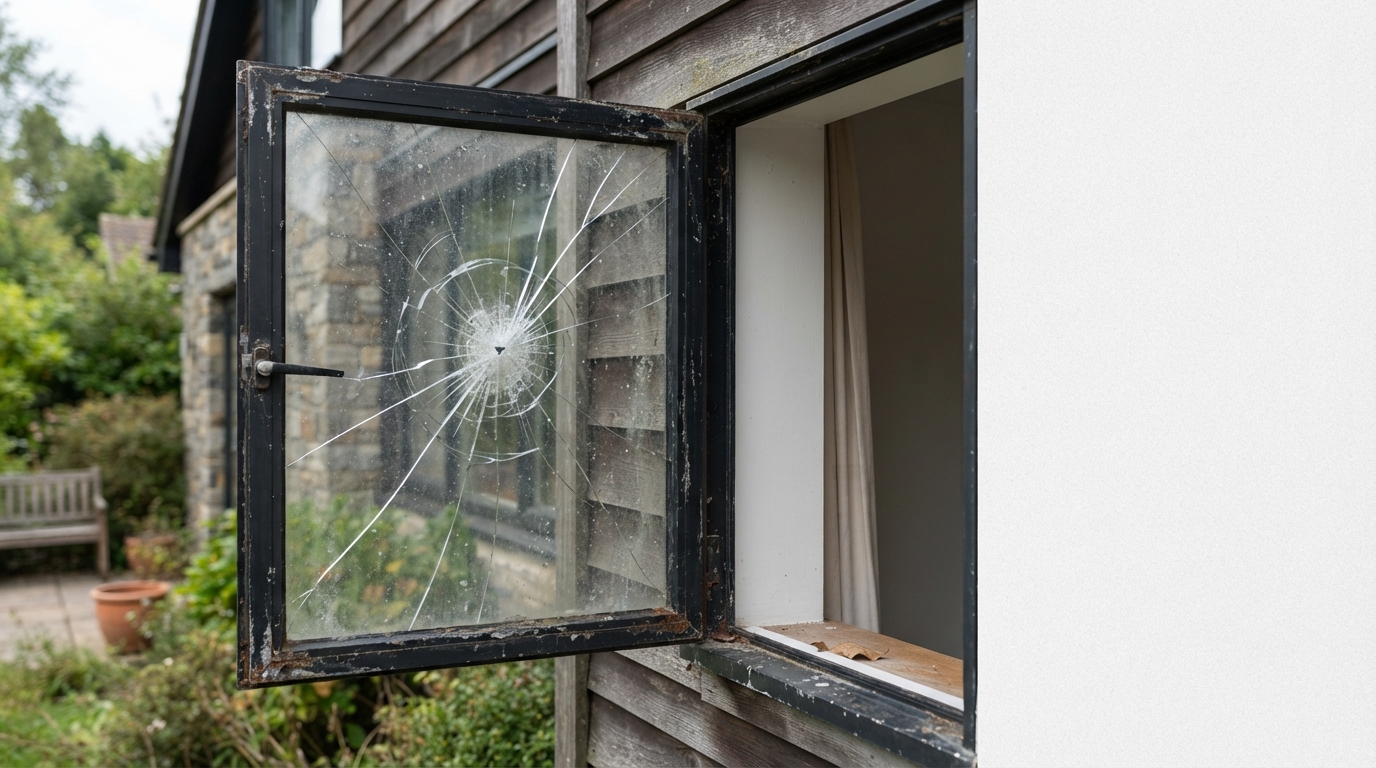
You noticed the crack a few weeks ago. It was small, barely more than a hairline near the corner of the pane, so you told yourself it could wait. The window still opens and closes. The glass still looks mostly fine from across the room. Nothing has broken.
But “nothing has broken” and “nothing is happening” are two very different things. A cracked window isn’t a finished event that occurred once and is now over. It’s a process that’s already in motion, and that process doesn’t pause just because you haven’t gotten around to dealing with it yet.
This article looks at what actually happens to cracked glass over time: the physical changes happening inside the pane, the stages that deterioration tends to move through, the warning signs worth paying attention to, and why a professional’s perspective matters more than most homeowners realize. The goal isn’t to alarm you over a hairline mark near the corner of your window. It’s to give you a clearer, more accurate picture than “it’s probably fine” or “it’s definitely an emergency,” because the truth for most cracked windows sits somewhere in between, and knowing where helps you make a better decision.
Why a Small Crack Rarely Stays Small
Glass is strong, but it isn’t flexible, and it doesn’t heal. Once it cracks, that break becomes the weakest point in the entire pane. Every bit of stress the glass experiences afterward (heat, cold, wind, vibration, even the ordinary settling of a house) gets concentrated right at the tip of that crack, rather than being spread evenly across the surface the way it would be in undamaged glass.
Think of it like a small tear in a piece of fabric. The tear itself doesn’t do the damage. It’s every pull and stretch after the tear that makes it bigger, because the fabric around the tear is no longer sharing the load the way the rest of the material is. Glass behaves in a similar way. The crack becomes a starting point, and everyday conditions do the rest of the work, often so gradually that you don’t notice until the change is significant.
This is part of why a crack that looked stable for a month can suddenly seem much longer the next time you really stop and look at it. Nothing dramatic had to happen. The glass was simply responding, bit by bit, to conditions it would have handled without issue if it were still intact.
It’s also worth understanding that this process isn’t linear or predictable in a way you can time on a calendar. Some cracks appear to sit still for months. Others visibly change within weeks. The variation comes down to where the crack is located, how the glass was originally installed, and what kind of everyday stress the window happens to be exposed to. That’s exactly why “just keep an eye on it” only works if you actually know what you’re watching for.
What’s Really Happening Inside the Glass Over Time
Everyday Temperature Changes
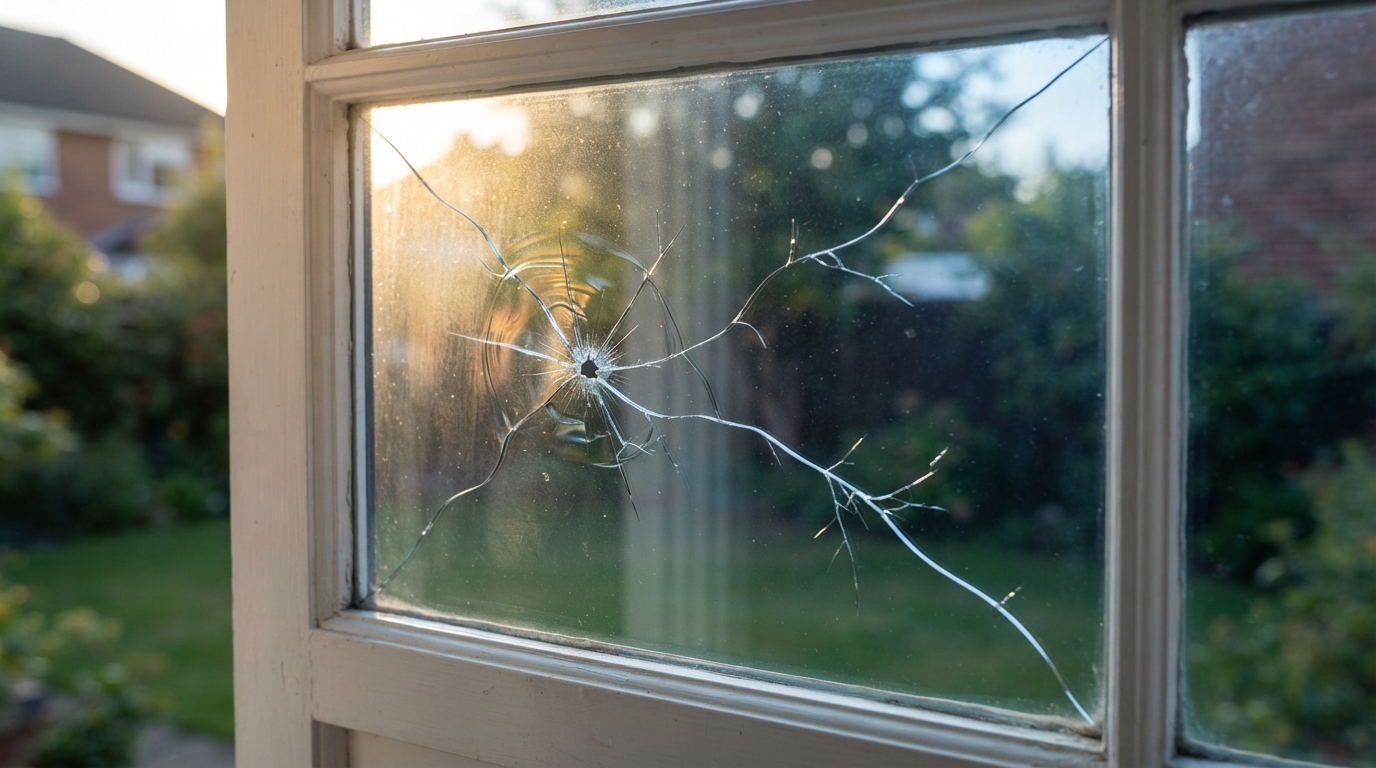
Glass expands slightly when it warms and contracts slightly when it cools. In an intact pane, that movement is even across the whole surface and completely harmless; the glass simply flexes as one unit. In a cracked pane, though, the two sides of the crack expand and contract at slightly different rates, because the crack interrupts that even movement. That mismatch puts repeated mechanical stress on the same weak point, day after day, season after season.
This is part of why cracks often seem to grow during seasonal transitions, or after a run of unusually hot or cold days. The glass isn’t reacting to one dramatic event. It’s responding to the accumulated effect of thousands of small temperature swings acting on a surface that’s already compromised.
Pressure and Structural Movement
Wind pressure, changes in indoor air pressure, and even the normal settling of a home’s frame over time all place small mechanical loads on window glass. Intact glass absorbs this without any visible effect. Cracked glass has already lost some of that structural continuity, so the same everyday pressure changes that a healthy pane shrugs off can nudge the existing crack a little further along.
None of this requires a storm or a dramatic impact. It’s the accumulation of entirely ordinary conditions, the kind every window in your home experiences constantly, acting on glass that’s no longer at full strength.
Vibration and Everyday Use
Doors closing nearby, foot traffic on nearby floors, and even the operation of the window itself all introduce small vibrations. In healthy glass, these vibrations are absorbed harmlessly. In cracked glass, they add to the cumulative stress at the crack tip, contributing, usually very gradually, to the same slow-motion process described above.
The Stages of Window Glass Deterioration
Deterioration isn’t all-or-nothing, and it doesn’t happen the moment a crack appears. It tends to move through recognizable stages, and understanding roughly where a crack sits can help you judge how much attention it actually needs right now versus how much it might need soon.
| Stage | What It Looks Like | What It Means |
| Early stage | A small, stable-looking crack, often near an edge or corner | The glass is compromised but the crack hasn’t yet begun actively spreading |
| Active spreading | The crack visibly lengthens over days or weeks; new hairline branches may appear | Ongoing stress is being concentrated at the crack tip and the glass is weakening further |
| Seal or frame compromise | Fogging or moisture between panes (in insulated units), drafts, or difficulty opening/closing | The issue may no longer be limited to the glass itself |
| Structural failure risk | Crack spans most of the pane, glass flexes or feels unstable, sharp edges are exposed | The window is at meaningful risk of sudden failure and needs prompt professional attention |
Most cracked windows that homeowners live with day to day sit somewhere between the early stage and active spreading. That’s exactly the point where a professional assessment does the most good, before the issue has a chance to move further down the list. Waiting until a window reaches seal compromise or structural failure risk generally means fewer options and a more involved solution than if the same window had been evaluated earlier.
It’s also worth noting that these stages don’t always progress at the same pace in every window. A crack in a high-stress location (near a corner, close to the frame, or on a window that gets significant sun exposure) can move through these stages faster than a crack in a more sheltered spot. That’s part of why two homeowners can have visually similar cracks with very different outcomes.
Warning Signs That Shouldn’t Be Ignored
Not every cracked window needs urgent attention, and treating every hairline mark as an emergency isn’t realistic or necessary. But certain signs suggest the deterioration has moved past the “just keep an eye on it” stage and into territory worth having someone actually look at:
- The crack has visibly grown since you first noticed it, even slightly
- Fogging, haze, or moisture trapped between panes of a double- or triple-pane window
- A draft near the window even when it’s fully closed and latched
- Increased difficulty opening, closing, or latching the window compared to before
- Gaps forming between the glass and the frame, which can indicate the seal or fit has shifted
- The crack runs close to the edge of the pane, where glass tends to be more vulnerable to further stress
- New branching cracks appearing off the original crack line
If you notice one or more of these, it’s a reasonable time to have the window looked at rather than waiting for a more obvious problem, like a much longer crack or a sudden failure, to force the issue.
Why “It’s Just a Small Crack” Can Be Misleading
It’s an understandable assumption. The window still functions, the room still feels normal, so it’s easy to mentally file the crack under “cosmetic, deal with it eventually.” But a few things tend to get overlooked when a crack is judged only by how it looks.
Safety. A cracked pane has reduced structural integrity compared to intact glass. Under enough stress, a slammed door, a storm, an accidental bump from furniture, or simply continued everyday stress on an already-weakened point, it can fail more suddenly and unpredictably than intact glass would. This matters most in homes with children, pets, or high-traffic areas near the window.
Comfort and efficiency. Even a hairline crack can create a small path for air movement. According to the U.S. Department of Energy, air leakage through windows and other gaps in a home’s envelope is a meaningful contributor to heat loss and heat gain, which affects both comfort and energy use inside the home. A crack doesn’t have to be large to start contributing to that effect.
Long-term performance. If a crack has compromised the seal on an insulated window, moisture can gradually work its way between the panes. ENERGY STAR notes that windows with air leaks, drafts, or degraded components are common indicators that a window’s overall performance has declined and may need attention. Once fogging between panes appears, it’s generally a sign that the issue has moved beyond the glass itself.
Appearance and home value. A visible crack, especially one that’s grown or spread, is noticeable to you, to guests, and eventually to anyone evaluating the home. While this is a smaller concern than safety or performance, it’s part of the full picture.
None of this means every small crack is an emergency requiring same-day attention. It does mean that “small” and “insignificant” aren’t the same thing, and that the two are easy to confuse when you’re looking at a window every day and gradually getting used to how it looks.
What a Professional Assessment Actually Looks At
A meaningful difference exists between guessing based on how a crack looks and actually knowing what’s happening with the window. A thorough professional assessment doesn’t just glance at the visible crack. It considers the glass, the seal on insulated units, and the surrounding frame together, because a problem that starts in one area often relates to or affects the others.
This is where a company like Hansen Glass can help. Rather than treating a crack as an isolated cosmetic issue to patch over, a proper assessment identifies whether the damage is limited to the glass itself or points to a broader concern involving the seal or frame, and that distinction changes what the right next step actually is. A crack that’s purely cosmetic and stable calls for a different response than one that’s connected to a failing seal or a stressed frame, and that difference usually isn’t obvious from a quick visual check alone.
This kind of assessment also accounts for factors many homeowners wouldn’t think to consider on their own: how the window is situated relative to sun exposure, how the surrounding structure may be contributing to stress on the frame, and what the existing materials and installation conditions suggest about how the glass is likely to behave going forward.
When to Stop Waiting and Get It Looked At
There’s no need to panic over every hairline crack the moment you spot it, and there’s nothing wrong with monitoring a stable, early-stage crack for a reasonable period of time. But there is a point where waiting stops being a reasonable, measured choice and starts being a risk you’re taking on without fully realizing it, usually once you notice active growth, drafts, fogging, or any of the warning signs described above.
If you’re at that point, or simply unsure which stage your window is actually in, Hansen Glass can assess the situation and help determine the right professional solution based on what’s actually happening with the glass, not just how it happens to look from a few feet away on a given day. Getting that clarity early is generally far more useful than continuing to guess.
The Value of Getting It Right the First Time
A cracked window is rarely just about the glass in isolation. It’s connected to how comfortable your home feels day to day, how well it holds conditioned air, and how it performs the next time weather or everyday stress puts real pressure on it. Addressing the issue with a proper, informed assessment, rather than simply hoping it holds until some vague future point, is what actually protects that performance over time.
That’s ultimately the difference professional insight makes: not just identifying that a window is cracked, which is obvious to anyone, but understanding what that crack actually means for the window as a whole, and what it’s likely to mean going forward if left alone. When you’re ready for that kind of evaluation, Hansen Glass is available to help you understand your options and move forward with a clearer picture than you started with.
Conclusion
A cracked window isn’t a single moment of damage that’s already over. It’s the start of an ongoing process shaped by everyday heat, cold, pressure, vibration, and structural movement, all the ordinary conditions your home experiences constantly. Left alone, that process tends to continue, sometimes slowly enough that you barely notice, and sometimes not.
Understanding the stages of deterioration and recognizing the warning signs gives you a far clearer picture than simply hoping the crack stays put, or assuming the worst without any real basis. And when it’s time for a real answer, a professional assessment looks at the whole picture, the glass, the seal, and the frame together, so that whatever solution follows actually fits the problem you have, rather than just the part of it you can see.
Frequently Asked Questions
Does a cracked window get worse over time even if I don’t touch it? Often, yes. Temperature changes, pressure differences, vibration, and normal structural movement all continue to place stress on the crack, which can cause it to lengthen or branch even without any new impact or accident.
Is a cracked window a safety concern right away, or only eventually? It depends on the crack’s size, location, and current stage of deterioration. A small, stable, early-stage crack may pose limited immediate risk, while a longer or actively spreading crack increases the chance of sudden, unpredictable failure.
Can a cracked window affect my home’s energy efficiency? Yes. Cracks can create small paths for air leakage, and if the seal on an insulated unit has been compromised, the window’s overall performance can decline further over time, sometimes showing up as higher energy use or noticeable drafts, as described by the U.S. Department of Energy.
How do I know if a crack means the whole window needs attention, not just the glass? Signs like fogging between panes, drafts, or increased difficulty opening and closing suggest the issue may extend beyond the glass to the seal or frame, something best confirmed with a professional assessment rather than a guess.
What does a professional look at when assessing a cracked window? A thorough assessment considers the glass itself, the condition of the seal on insulated units, and the surrounding frame, since deterioration that starts in one area often relates to or affects the others.