
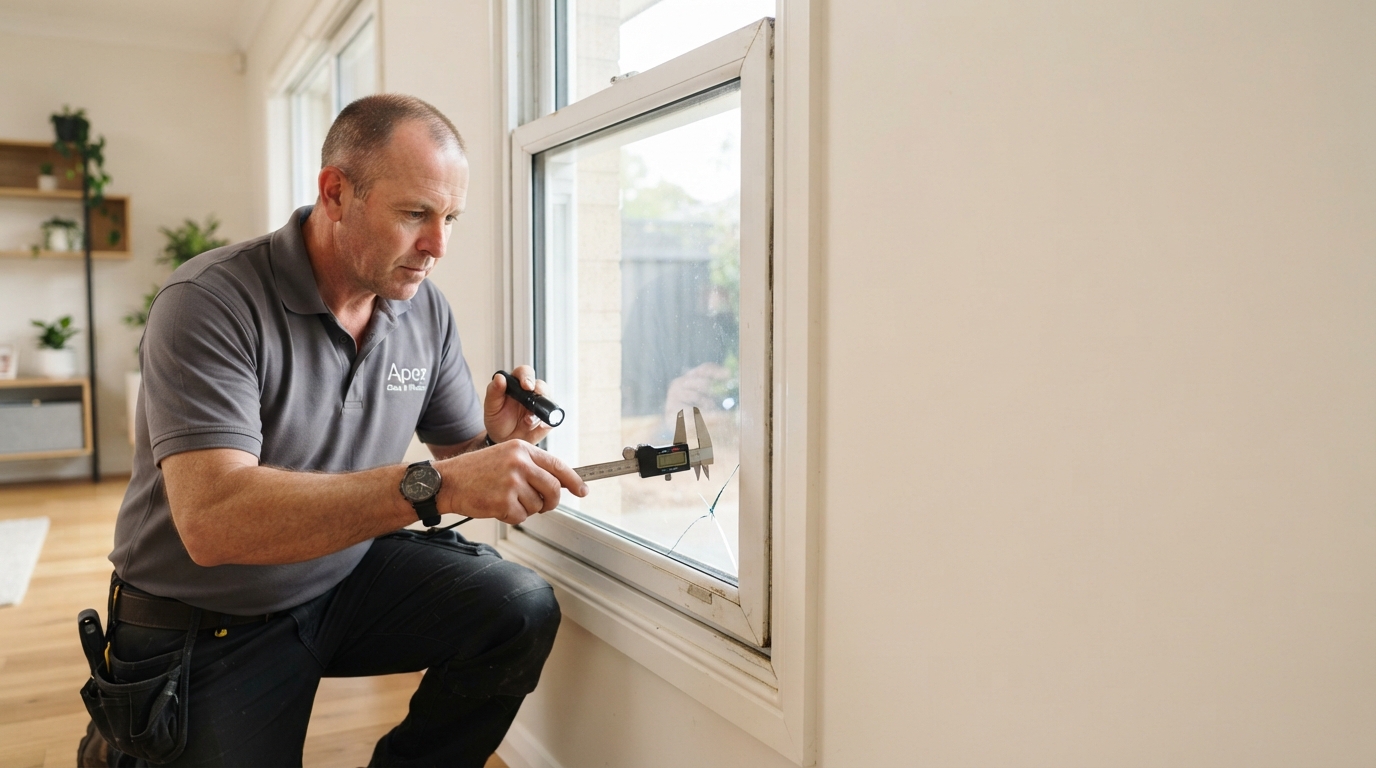
A homeowner calls about a cracked window pane near the corner of the frame. A technician comes out, replaces the glass, and everything looks perfect for a few months. Then, quietly, a new crack shows up in almost the same spot. It’s tempting to assume the glass was just bad luck twice. More often, the real story is something nobody looked at the first time: the frame.
Situations like this play out more often than people expect. A pane gets replaced, the homeowner is relieved to have a clear view again, and then a season or two later, the same problem resurfaces. By that point, it’s easy to feel like glass repair just doesn’t hold up, when really the first repair only ever addressed half the problem.
When a professional evaluates a glass repair job, the glass itself is only part of the picture. The frame around it plays a much bigger role than most homeowners realize, and skipping a close look at its condition is one of the most common reasons a “fixed” window doesn’t stay fixed.
This article walks through why frame condition matters so much in a glass repair evaluation, what a thorough professional actually checks, how frame material changes that process, and the warning signs that suggest your frame, not just your glass, needs attention.
When “Just the Glass” Isn’t the Whole Story
It’s natural to see a crack or a foggy pane and assume the fix is simple: pull out the damaged glass, drop in new glass, done. For a lot of repairs, that really is the whole job.
But glass doesn’t exist in isolation. It sits inside a frame that holds it in place, absorbs everyday movement, and is supposed to keep pressure evenly distributed across the pane. When that frame is weakened, warped, or out of alignment, it can pass stress directly into the glass, even glass that was installed correctly.
That’s why an experienced technician doesn’t just look at the damage. They look at what’s holding the damage in place. A crack that starts right at the edge of the frame, for example, often points to pressure coming from the frame itself rather than a random impact. Treating that as a simple glass swap, without addressing what caused the stress in the first place, tends to set the new pane up to fail the same way.
What “Frame Condition” Actually Means
“Frame condition” sounds like a vague phrase, but in a professional evaluation it breaks down into a few specific things a technician is checking for.
Structural alignment. Is the frame still square, or has it shifted or twisted over time? Even a small amount of twist changes how force travels through the frame every time a window is opened, closed, or exposed to wind. A frame that’s out of alignment can put uneven pressure on the glass with every use, long before that pressure shows up as a visible crack.
Warping or decay. Wood frames can soften or rot where moisture has been sitting, especially at joints and along the bottom rail where water tends to collect. Vinyl and aluminum frames don’t rot, but they can warp under sustained heat, flex under impact, or develop small gaps at the corners as the material ages. Either way, a frame that’s no longer rigid can’t support glass the way it was designed to.
Moisture damage. Water that’s found its way into the frame, through a failed seal, a small gap, or simple age, can weaken the material from the inside, long before it’s visible from the outside. By the time staining or softness is obvious, the moisture has often been working on the frame for a while.
Hardware stability. Loose or worn hinges, tracks, and locks can allow the frame to shift slightly every time the window or door is operated. Individually, that shift is tiny. Over hundreds of open-and-close cycles, it adds up to real, repeated stress on the glass sitting inside it. The U.S. Department of Energy’s guide to energy-efficient windows notes that proper installation and a stable, well-maintained frame are just as important to a window’s long-term performance as the glass itself.
None of these show up by just glancing at the crack. They show up when someone actually checks the frame itself, which is exactly why that step shouldn’t be treated as optional.
How Frame Condition Affects a Glass Repair
A compromised frame doesn’t just sit there quietly. It actively works against a glass repair in a few specific ways:
- Uneven pressure on new glass. A warped or misaligned frame can squeeze or twist the glass slightly, creating stress points that lead to cracking again.
- Poor seal performance. If the frame isn’t holding its shape, the seal between the frame and the glass can’t do its job, which invites drafts and moisture.
- Recurring cracks in the same area. Glass replaced in a damaged frame often cracks again near the same spot, because the underlying cause was never addressed.
- Reduced lifespan of the repair. Even if the new glass doesn’t crack outright, ongoing stress from the frame can shorten how long the repair holds up.
- Operational problems. A frame under stress can make the window or door harder to open, close, or lock properly, independent of the glass itself.
Each of these on its own might seem minor. Together, they explain why a homeowner can pay for a glass repair, feel satisfied for a while, and then find themselves right back where they started, except now with a second repair bill and the same underlying issue still unresolved. This is why a repair that only addresses the glass can end up being a temporary fix dressed up as a permanent one.
What a Thorough Professional Evaluation Actually Checks
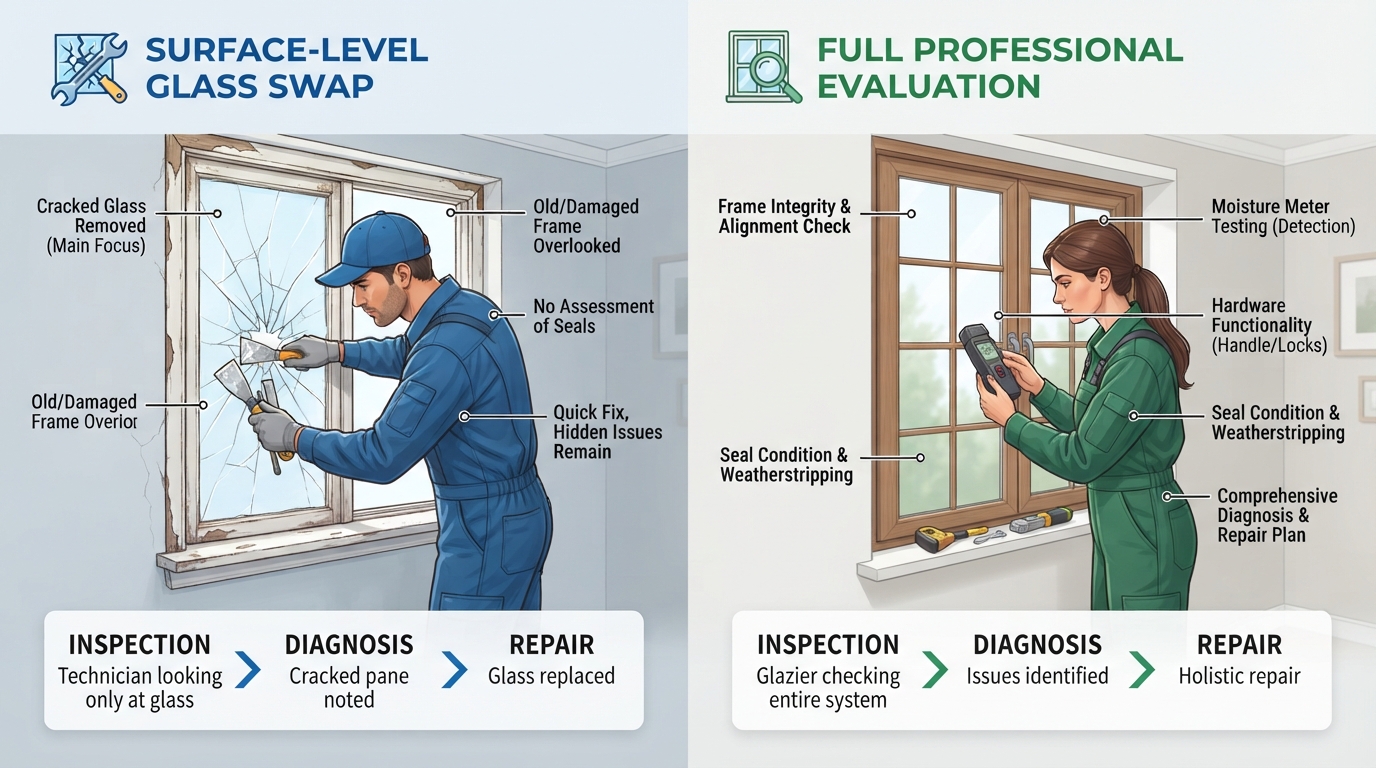
A careful evaluation looks at the glass and the frame together, not as two separate jobs. Here’s a simple way to see the difference between a surface-level glass swap and a full evaluation:
| What’s Checked | Surface-Level Glass Swap | Full Professional Evaluation |
| Visible crack or damage | Yes | Yes |
| Frame alignment and squareness | Not checked | Checked |
| Moisture damage inside the frame | Not checked | Checked |
| Hardware and hinge stability | Not checked | Checked |
| Seal condition between frame and glass | Not checked | Checked |
| Root cause of the damage | Assumed to be the glass | Identified before repair |
| Likelihood of the same issue recurring | Higher | Lower |
A technician doing a full evaluation will typically look at the frame from both the interior and exterior, check whether it’s holding square, test for soft or damaged spots, and confirm the hardware is still doing its job. They may also check how the frame is seated in the surrounding opening, since a frame that’s shifted within the wall can create the same kind of stress as a frame that’s warped on its own. Only after all of that does it make sense to talk about how to handle the glass itself, because the right repair depends on what’s actually going on around it.
This distinction matters more than it might seem. A repair plan built around the glass alone treats the crack as the problem. A repair plan built around a full evaluation treats the crack as a symptom, and addresses whatever caused it. The second approach takes a little more time upfront, but it’s the difference between fixing something once and fixing it repeatedly.
This is the kind of evaluation Hansen Glass performs on every glass repair call: not just measuring the damaged pane, but understanding the condition of the frame it sits in, so the fix that’s recommended is one that’s actually going to hold.
How Frame Material Changes the Evaluation
Not every frame ages the same way, so a professional adjusts what they’re looking for based on what the frame is made of.
Wood frames are the most prone to moisture-related problems. A technician checking a wood frame will pay close attention to joints, sills, and any area where paint or sealant has worn thin, since that’s usually where water finds a way in first. Softness when pressed, discoloration, or a slightly spongy feel are all signs of decay that can undermine how well the frame supports the glass.
Vinyl frames don’t rot, but they can warp when exposed to prolonged heat, especially on south- or west-facing windows. A technician will look for slight bowing along the frame edges, gaps that have opened at the corners, or a sash that no longer sits flush, all of which can throw off how evenly the glass is supported.
Aluminum frames are strong but can dent, bend, or corrode over time, particularly near the coast or in humid climates. Corrosion around fasteners and hardware is a common check point, since it can loosen the connection between the frame and the surrounding structure well before any damage is visible in the glass itself.
Knowing the material helps a technician know exactly where problems are most likely to start, rather than treating every frame the same way.
Warning Signs the Frame May Be Part of the Problem
You don’t need to be a technician to notice some of these signs yourself. If any of the following sound familiar, it’s worth mentioning to whoever evaluates your glass:
- The window or door has become harder to open, close, or lock than it used to be. This is often one of the earliest signs of frame movement, and it usually shows up before any glass damage does.
- You feel a draft or hear a faint whistle near the glass, even though the glass itself looks intact. Air finding its way through an otherwise solid-looking window is a strong signal that the seal around the frame has been compromised.
- A crack has shown up in roughly the same spot more than once. Repeated cracking in the same location is one of the clearest indicators that something structural, rather than random impact, is behind the damage.
- You can see visible warping, soft spots, or discoloration on the frame. These are outward signs of a problem that’s likely been developing for some time beneath the surface.
- There’s moisture staining or a musty smell near the window or door frame. This often points to water intrusion that’s affecting the frame material itself, not just the surface finish.
None of these guarantee a frame problem on their own, but together they’re a good reason to ask for a full evaluation rather than a quick glass-only fix.
Why Skipping the Frame Check Costs More in the Long Run
It’s easy to see a frame check as an extra step that slows things down. In practice, it’s the step that prevents you from paying for the same repair twice.
If a damaged frame is left unaddressed, the new glass is essentially sitting on the same unstable foundation that contributed to the original problem. That often means another crack, another service call, and another round of the same conversation, except now there’s also whatever damage the frame issue caused in the meantime, like ongoing drafts or moisture creeping further into the surrounding wall or nearby framing.
There’s also a comfort and efficiency cost that’s easy to overlook. A frame that’s no longer sealing properly lets conditioned air escape and outside air in, which means a heating or cooling system works harder than it should, month after month, even if the glass itself looks perfectly fine. According to ENERGY STAR’s guidance on sealing and insulating a home, addressing air leaks like these is one of the most effective ways to improve comfort and efficiency. That’s a quieter cost than a repeat repair bill, but it adds up in the same way.
A proper evaluation up front costs a bit more time. Skipping it tends to cost more overall, just spread out over a longer, more frustrating timeline, and it often shows up in places beyond the window itself.
Getting a Repair That’s Actually Built to Last
The glass is the part you notice first, but the frame is what determines whether a repair actually solves the problem or just delays it. A professional who checks both is doing more than being thorough. They’re protecting the investment you’re making in the repair itself.
If you’re dealing with a window or door where the glass keeps failing, feels drafty, or has become difficult to operate, Hansen Glass can evaluate the frame and glass together and help you understand exactly what’s going on before any work begins. That’s the difference between a repair that looks fine for a few months and one that actually holds up.
Conclusion
A glass repair is only as good as what’s supporting it. Frame condition affects how much pressure the glass is under, how well the seal performs, and whether the same crack is likely to come back. A professional evaluation that includes the frame, not just the visible damage, gives you a much clearer picture of what’s really going on, and a repair that’s far more likely to last. Next time you’re dealing with a glass issue, it’s worth asking whether the frame has been checked, not just the pane.
Frequently Asked Questions
Can glass be repaired if the frame is damaged?
Sometimes, but it depends on how significant the frame damage is. A professional evaluation will determine whether the frame needs attention first, alongside the glass, or whether it’s stable enough to support a straightforward glass repair.
How do I know if my problem is the frame and not the glass?
Signs like a window that’s hard to open or close, drafts near glass that looks undamaged, or a crack that keeps returning in the same spot often point to the frame. A professional evaluation is the most reliable way to confirm it.
Does frame material affect how it’s evaluated?
Yes. Wood, vinyl, and aluminum frames each show wear differently. Wood is more prone to moisture damage and rot, while vinyl and aluminum are more likely to warp or shift under heat and impact. A technician adjusts what they check based on the material.
Will a glass repair fail again if the frame isn’t fixed first?
It’s more likely to. If the frame is still putting uneven pressure on the glass or holding a poor seal, a new pane is working against the same conditions that likely contributed to the original damage.
What should a professional glass repair evaluation include?
At minimum, it should include an assessment of the glass damage itself, a check of the frame’s alignment and structural condition, a look at moisture or decay, and a review of hardware stability, not just a measurement for replacement glass.