
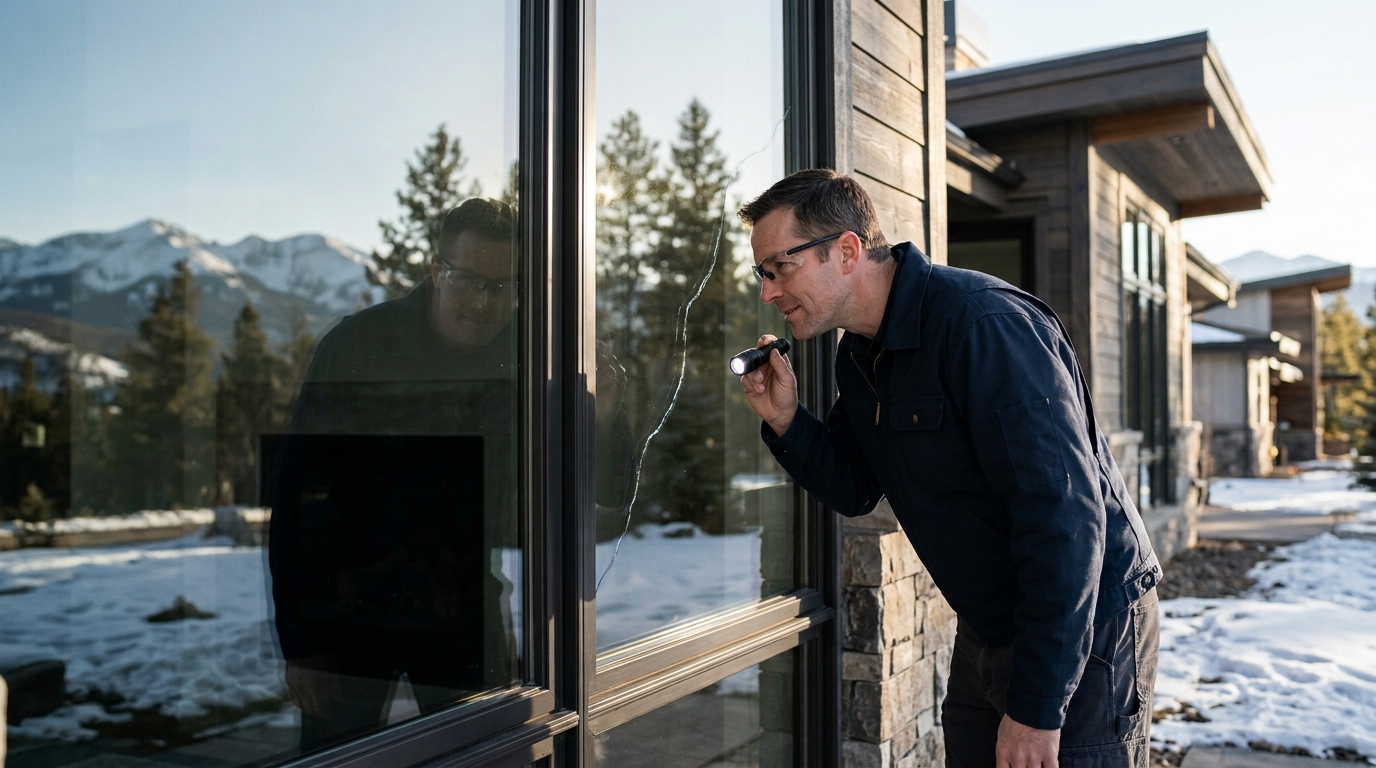
You walk past a window you’ve looked through a thousand times, and there it is: a clean, straight line running across the glass. No baseball. No hail. No slammed door. Nothing hit it. It just… cracked.
If this has happened to you, you’re not imagining things, and you’re not alone. This is one of the more common glass mysteries homeowners run into, especially here in Colorado. It’s called a thermal stress crack, and once you understand what causes it, the “mystery” stops feeling so strange.
This article walks through why these cracks happen, why Colorado’s climate makes them more common, how to recognize one, and what a professional actually checks for when they come to take a look.
What Is a Thermal Stress Crack, Really?
Glass expands slightly when it warms up and contracts slightly when it cools down. That’s normal. The problem starts when different parts of the same pane are at noticeably different temperatures at the same time.
Picture a window on a sunny winter afternoon. The center of the glass sits in direct sunlight and warms up quickly. But the edges of that same pane are tucked inside the frame, shaded from the sun, and staying much colder. Now you have one piece of glass trying to do two things at once: the warm center wants to expand, while the cold edge wants to stay put.
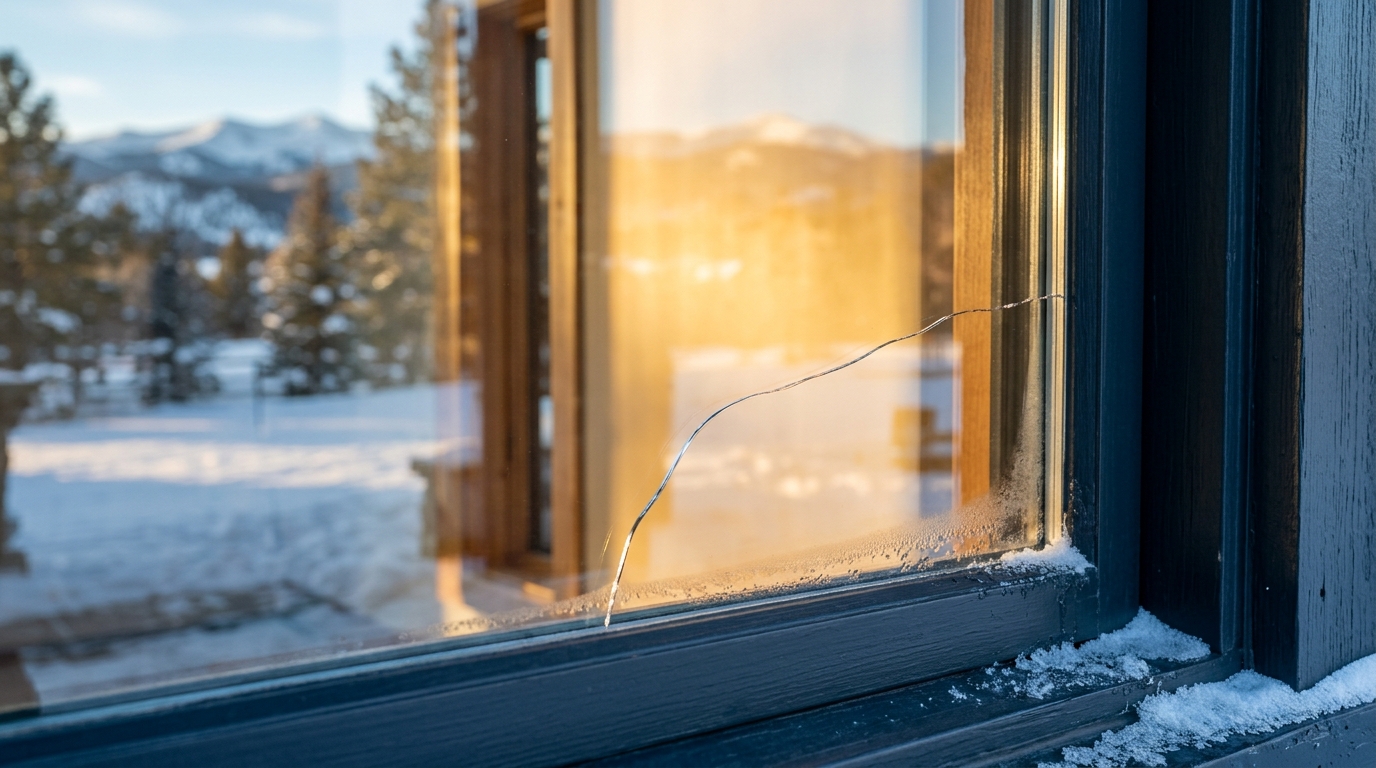
Glass is strong under compression but much weaker under tension, and it doesn’t flex to relieve that kind of pull. When the stress at the edge gets high enough, something has to give. The result is a crack that typically starts right at the edge of the pane and runs inward, often in a fairly straight or slightly curved line.
This is different from a crack caused by something hitting the glass, and it’s different from a pressure-related crack in a sealed insulated unit. It’s a temperature problem, not an impact problem.
Why Colorado Is Especially Hard on Glass
Every climate puts some thermal stress on glass. Colorado just happens to stack several risk factors on top of each other.
Big daily temperature swings. Along the Front Range, it’s common for a morning to start well below freezing and climb into the 60s or even higher by afternoon. According to National Weather Service climate data for the Denver area, daily temperature swings of 20 to 30 degrees are a routine part of the region’s weather pattern, and even larger swings show up during transitional months. That kind of daily whiplash is exactly the setup that creates uneven heating across a single pane of glass.
Intense, high-altitude sun. Thinner atmosphere at elevation means more direct solar radiation reaches the glass, especially on south- and west-facing windows during the afternoon. That sun heats the exposed center of a window fast, while the shaded, frame-covered edge lags behind.
Shoulder-season extremes. Spring and fall are often the worst stretches for thermal cracking, not because it’s colder, but because the sun angle is low and nights are still cold while afternoons can feel like summer. That daily swing between a cold morning and a sun-warmed afternoon repeats itself for weeks at a time.
Dry air and rapid cooling at night. Colorado’s low humidity means heat radiates away quickly after sunset, so the glass can cool off faster than in a more humid climate, adding another layer of temperature swing on top of the daytime heating.
Elevation and thinner atmosphere. The higher you go, the less atmosphere there is to filter incoming solar radiation. That’s part of why a sunny Colorado afternoon can feel noticeably more intense than the same temperature reading at sea level. Glass absorbs some of that extra radiant energy, which adds to how quickly the sun-facing side of a pane heats up relative to its shaded edge.
Chinook winds and rapid warm-ups. Along the Front Range, it’s not unusual for a warm downslope wind to push temperatures up by 20, 30, even 40 degrees in a matter of hours, sometimes overnight. A pane of glass that was sitting at a stable, cold temperature suddenly has warm air moving across its surface while snow or frost may still be clinging to the frame and edges. That mismatch, warm air on one part of the system and lingering cold on another, is another version of the same underlying problem: different parts of the glass assembly changing temperature at different rates.
None of these factors alone would necessarily crack a window. Together, they add up to a climate that puts more day-to-day thermal stress on glass than a lot of other parts of the country experience. It’s less about any single extreme temperature and more about how often, and how quickly, the glass is asked to handle a temperature swing.
How to Recognize a Thermal Stress Crack
Not every crack is a thermal stress crack, and it helps to know the difference before you assume the worst, or assume it’s nothing.
| Crack Type | Typical Appearance | Usual Cause |
| Thermal stress crack | Starts at the edge of the glass, runs fairly straight or gently curved, no visible point of impact | Uneven heating/cooling across the pane |
| Impact crack | Starburst or spiderweb pattern radiating from a central point | An object striking the glass |
| Pressure crack | Curved, hourglass-like shape, usually in sealed insulated units | Air pressure or elevation mismatch inside a sealed glass unit |
If your crack starts at the edge and there’s no dent, chip, or clear point where something hit the glass, thermal stress is a reasonable explanation. If it radiates outward from one spot, that points to impact instead.
What Makes Some Windows More Vulnerable
Two windows on the exact same house, installed at the exact same time, can have completely different experiences with thermal stress. The difference usually comes down to a handful of specific, identifiable factors, not bad luck. A few common risk factors show up again and again:
- Older or untreated glass. Standard annealed glass (the type common in older windows) has less built-in strength than tempered or heat-treated glass, so it tolerates less temperature difference before cracking. The U.S. Department of Energy’s guide to energy-efficient windows is a useful, neutral resource if you want to understand more about how glass and coating choices affect a window’s overall performance.
- South- and west-facing exposure. These windows catch the most direct, sustained sun during the hottest part of the day.
- Partial shading. A window that’s half in the sun and half shaded by a tree, awning, or neighboring structure creates a sharp temperature line right across the glass, often a bigger risk than a window that’s fully sunlit or fully shaded.
- HVAC vents aimed at the glass. A vent blowing cold air directly onto a sun-warmed pane (or hot air onto a cold one) can create a localized temperature swing strong enough to start a crack.
- Existing edge damage. A small chip or rough spot on the edge of the glass, even one left over from the original installation, creates a weak point where a crack is more likely to start.
- Frame movement. As a house settles over the years, a window frame can shift slightly and put extra pressure on the edge of the glass, making it more sensitive to thermal movement.
- Tinted, coated, or darker-colored glass. Glass that absorbs more solar energy tends to run hotter at its center than clear glass under the same sun exposure, which can widen the temperature gap between the center and the shaded edge.
None of these factors guarantee a crack will happen. They simply describe why some windows in a home are more prone to it than others, even when every window is exposed to the same outdoor weather.
Is a Thermal Stress Crack a Sign of a Bigger Problem?
Sometimes, and sometimes not. A single crack in an isolated, older single-pane window might genuinely just be a one-off event tied to that day’s sun and shade pattern.
But a crack can also be a signal worth paying attention to. If it’s part of a sealed insulated glass unit, the crack can affect the seal, which may lead to fogging or lost insulating performance over time. If cracks keep showing up in the same window, or in several windows on the same side of the house, that pattern can point to something more systemic: a frame that’s shifted, a glass type that’s mismatched to that window’s sun exposure, or edge damage that’s been there for a while.
This is really the heart of the issue: a crack that looks simple on the surface can have very different underlying causes, and those causes call for different responses. Guessing which situation you’re in isn’t a great strategy, which is exactly why a proper assessment matters.
What Professionals Actually Look For During an Assessment
When someone experienced in glass evaluates a thermal stress crack, they’re not just looking at the crack itself. A thorough assessment typically considers:
- Crack pattern and origin point: confirming it started at the edge and matches a thermal signature rather than impact or pressure damage
- Glass type and age: identifying whether the pane is annealed, tempered, or part of an insulated unit, since each behaves differently under thermal stress
- Orientation and shading: noting sun exposure, nearby trees or structures, and any partial-shade patterns that could explain the stress
- Frame and seal condition: checking whether the surrounding frame has shifted or whether a seal has been compromised
- History of the opening: whether this window has had prior issues, and whether similar cracks have shown up elsewhere on the same wall or exposure
Putting these pieces together is what separates an educated diagnosis from a guess. It’s also what determines whether the right next step is simply replacing that one pane, or addressing something bigger, like a frame issue or a glass type that isn’t well-suited to that window’s sun exposure.
There’s also a timing element to a good assessment. A crack that’s fresh and stable tells a different story than one that’s been slowly growing for months. Someone experienced in evaluating glass damage will often ask when the crack was first noticed, whether it’s changed in length or width since then, and whether it appeared after any specific event, like a cold snap, a heat wave, or a change in how the window is shaded. Those details help rule out or confirm thermal stress as the cause, rather than treating every crack as identical.
It’s also worth understanding what an assessment is not. It isn’t a sales pitch built around a single, predetermined outcome, and it isn’t a guess based on a quick glance from across the room. A proper evaluation takes into account the specific window, the specific exposure, and the specific history of that opening, because two windows on the same house can have very different stories behind an otherwise similar-looking crack.
Why Professional Assessment Matters More Than Guessing
It’s tempting to look at a crack, assume you know what caused it, and move on. But because thermal, impact, and pressure cracks can sometimes look similar at first glance, and because the underlying cause changes what the right fix actually is, an accurate diagnosis matters.
This is where a company like Hansen Glass fits in. Rather than assuming every crack needs the same response, a proper evaluation looks at the glass, the frame, the exposure, and the pattern of damage together, so the recommendation actually matches what’s going on with that specific window. That kind of assessment is what tells you whether you’re looking at a simple, isolated repair or something that points to a bigger underlying issue.
When to Call a Professional
You don’t need to be a glass expert to notice the signs that it’s time to get an evaluation. A few situations worth acting on:
- The crack is spreading or getting longer over time
- You notice fogging, moisture, or a hazy appearance between panes of an insulated window
- You feel a draft near the cracked window that wasn’t there before
- More than one window on the same wall or exposure has developed similar cracks
- The crack is in a window that’s difficult to reach or part of a larger, older window system
None of these situations call for DIY repair. Glass work involves real safety risk, and a cracked pane, especially one under ongoing thermal stress, isn’t something to handle without the right training and tools. If you’re seeing any of these signs, reaching out to Hansen Glass for an assessment is a reasonable next step, since determining the right course of action depends on factors specific to your property, including the glass type, the surrounding frame, accessibility, and what the inspection reveals.
Bringing It All Together
A window cracking with no obvious cause can be unsettling, but it’s rarely mysterious once you understand what’s happening. Colorado’s combination of big daily temperature swings, intense high-altitude sun, and dry, fast-cooling air creates near-ideal conditions for thermal stress on glass, especially on older, single-pane, or partially shaded windows.
The crack itself isn’t the whole story. What matters is understanding why it happened and whether it points to something bigger. That’s where a professional set of eyes is worth more than a guess. If you’re dealing with a crack like this, Hansen Glass can walk through what the pattern, the glass type, and the surrounding frame are telling you, and help you understand the right next step from there.
Frequently Asked Questions
Can a thermal stress crack spread over time? Yes. Because the underlying temperature swings that caused the crack keep happening day after day, an existing crack can slowly extend further across the pane, especially through additional hot and cold cycles.
Does a thermal crack mean the whole window needs to be replaced? Not necessarily. Sometimes it’s isolated to a single pane, while other times it points to a broader issue with the frame or the glass unit’s seal. This is exactly why an assessment matters rather than assuming one outcome.
Why do these cracks seem to happen more in spring and fall? Shoulder seasons combine a lower sun angle, cold nights, and warm, sunny afternoons, which creates a bigger temperature difference across the same pane of glass than you’d typically see during a stable summer or winter stretch.
Is a thermally cracked window still safe in the short term? A stable crack in a single pane is often not an immediate hazard, but it should still be evaluated, since cracks can spread and may affect the seal or structural integrity of the surrounding frame over time.
How is a thermal crack different from a crack caused by pressure? A thermal crack usually starts at the edge and runs in a relatively straight or gently curved line, while a pressure-related crack, which typically shows up in sealed insulated glass units, tends to have a curved, hourglass-like shape tied to air pressure differences rather than temperature.