
A friend of mine was renovating her home last year and called me in a panic. Her contractor had asked her to choose between tempered glass and laminated glass for her new patio doors and she had no idea what that meant. Honestly, most people don’t. But when it comes to safety glass standards for tempered vs. laminated applications, picking the wrong type can mean failing a building inspection or putting people at real risk. Let me walk you through everything you need to know in plain, simple words.
What Is Safety Glass and Why Buildings Need It?
Safety glass is not just stronger glass. It is glass that is designed to protect people when it breaks. Normal glass, which builders call annealed glass or regular glass, shatters into long, sharp pieces when it breaks. Those pieces can cause terrible cuts.
Safety glass is built differently. It either breaks into small harmless pieces or stays in one piece even after it cracks. That is what makes it safe to use in places where people walk, lean, push or fall against glass every day.
According to the National Glass Association, safety glass is required in certain areas of every building. Any glass panel less than 18 inches above the floor needs to be safety glass. Glass in or near doors, glass railings and bathroom enclosures all fall under the same rule. It is not just a choice you make for your own peace of mind. In most US states it is the law.
The Two Types Every Builder and Homeowner Should Know
There are two main kinds of safety glass used in buildings across the US. These are tempered glass and laminated glass. Both count as safety glazing materials under US codes. But they work in completely different ways.
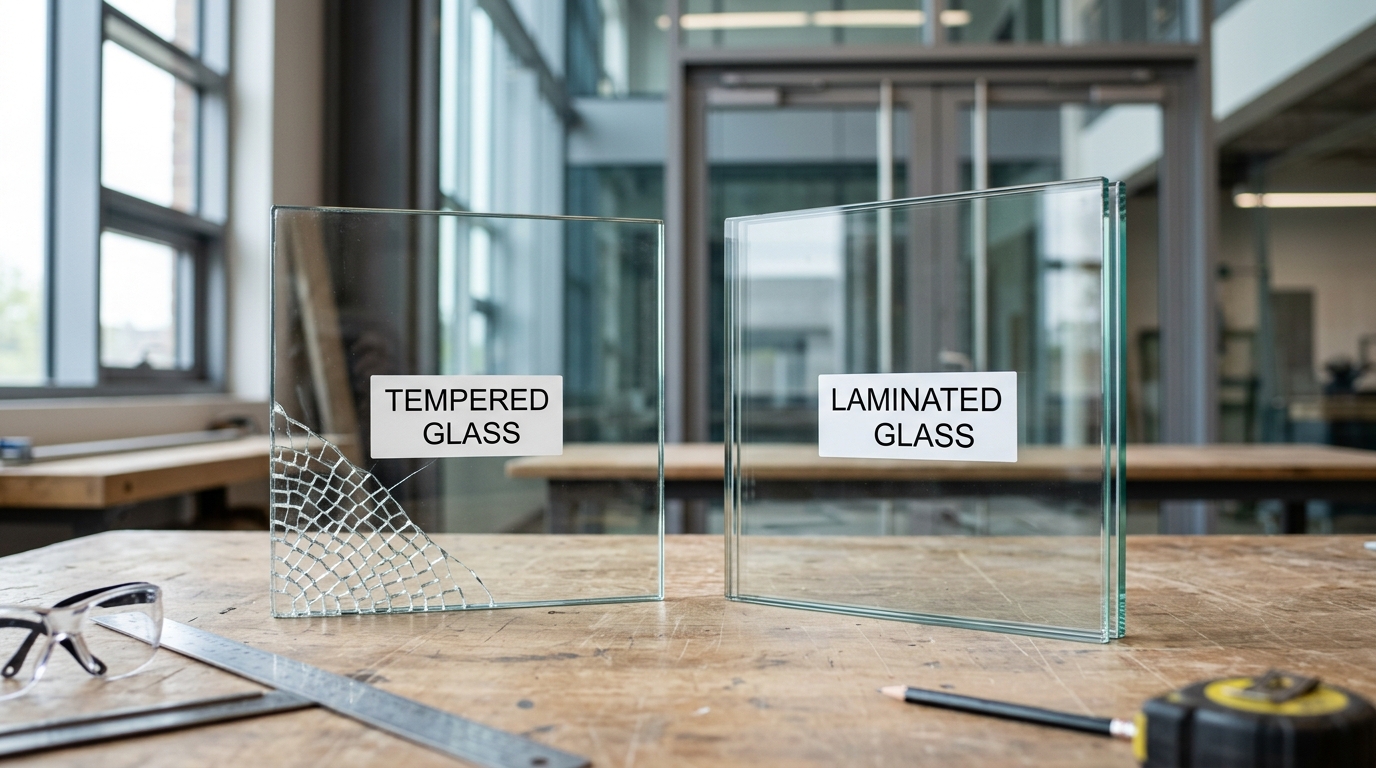
Tempered glass goes through a special heating and cooling process that makes it much harder than regular glass. When it breaks it falls into many small, rounded pieces instead of sharp shards.
Laminated glass is made by bonding two or more pieces of glass together with a plastic layer called polyvinyl butyral (PVB). When this glass breaks the pieces stay stuck to that plastic layer. The glass does not fall apart or fall down. It holds its shape even after impact.
Choosing between them depends on where the glass will go, what risks are in that location and what your local building codes require.
How Each Type of Safety Glass Is Made
How Tempered Glass Is Created with Heat and Fast Cooling
The tempering process starts with ordinary annealed glass cut to the exact size and shape needed. This is important because once the glass is tempered, you cannot cut or drill it anymore. Any changes to the size after tempering will cause the whole pane to shatter instantly.
The cut glass goes into a tempering furnace where it is heated to around 1,200 degrees Fahrenheit. Then it is cooled down very fast using strong blasts of cold air. This rapid cooling is called quenching.
Because the outside of the glass cools faster than the inside, it creates surface compression on the outer layers and internal tension at the core. That balance of forces is what gives tempered glass its strength and its unique breakage pattern. The result is glass that is roughly four to five times stronger than the same piece of glass before the tempering process.
I once visited a glass processing plant in Texas and watching the quenching stage was genuinely surprising. The glass goes in looking ordinary and comes out looking exactly the same but it is a totally different material inside. You would never know just by looking at it.
How Laminated Glass Gets Its Bonded Layers
To make laminated glass, two or more pieces of glass are placed on either side of a thin interlayer material. The most widely used interlayer is polyvinyl butyral (PVB). Some projects use ethylene-vinyl acetate (EVA) for specific needs. Buildings near busy roads or airports often choose acoustic PVB because it blocks more sound than standard PVB.
The whole assembly goes into a special press where heat and pressure are applied together. This process bonds everything tightly into a single unit. The result looks like a regular piece of glass but it has that hidden plastic sheet fused inside it.
One thing that surprises people is that the interlayer can also be colored, patterned or even printed with images. Architects and designers use this to add creative effects to glass in lobbies, storefronts and public spaces. You get the safety of laminated glass and a design feature at the same time. That is a combination most people do not expect.
What Happens When Each Glass Breaks
Tempered Glass: Tiny Safe Cubes Instead of Dangerous Shards
The moment tempered glass breaks it does not crack in one spot. The entire pane shatters at once into hundreds of small, rounded pieces. These are often described as looking like tiny cubes or pebbles. That is the breakage pattern that earns tempered glass its place as a certified safety glazing material.
These small cube-like fragments can still scratch your skin. But they will almost never cause the deep lacerations that regular glass causes. That is the whole point of this breakage pattern and it is what standards like ANSI Z97.1 specifically test for when certifying tempered glass.
Here is what many people do not think about, though. Once tempered glass shatters, the entire pane is gone. There is now a wide-open hole where the glass used to be. In a high-rise building or a balcony situation, that can be very dangerous for people nearby. There is no remaining barrier at all.
Laminated Glass: Cracked but Still in One Piece
Laminated glass behaves in the opposite way. When it is hit hard enough to crack, the glass panels may fracture and break. But the PVB interlayer holds all the pieces together. The cracked pane does not fall out, does not rain down in pieces and does not leave an open hole. Experts call this ability post-break containment.
This is the reason laminated glass is required in skylights and overhead glazing in most US building codes. If glass above you cracks and falls, even small pieces can cause serious harm. Laminated glass solves this problem completely by keeping the broken pieces bonded to the interlayer.
Post-break containment also matters a lot for security. If someone tries to smash through a laminated glass window or door, the glass cracks but the PVB interlayer keeps it together. This slows down any attempt at forced entry significantly. Tempered glass offers zero resistance once it shatters because there is simply nothing left to resist with.
The Safety Standards That Govern Both Glass Types
ANSI Z97.1 and CPSC 16 CFR 1201 Explained
If you look closely at the edge of a shower door, a glass office partition or an entry door, you will usually find small text printed or etched right on the glass. Those letters and numbers are certification markings. The two most important ones in the US are ANSI Z97.1 and CPSC 16 CFR 1201.
According to the ANSI Blog, ANSI Z97.1 is the American National Standard for safety glazing materials used in buildings. It sets exact rules for how glass must perform during impact tests, weathering tests and fragmentation tests. Both tempered glass and laminated glass must pass specific versions of these tests to earn their certification.
CPSC 16 CFR 1201 is different. It is a federal law in the United States, created by the Consumer Product Safety Commission. It applies mainly to glass in and near doors. Any glass panel bigger than 9 square feet placed in or near a door must pass the higher Category II test. That test drops a 100-pound bag filled with lead shot from 48 inches to simulate the full force of a person running into a glass door.
For laminated glass, the ANSI Z97.1 standard also requires a boil test and a weathering test. These check whether the PVB interlayer stays bonded and keeps working after years of heat, humidity and weather exposure. Tempered glass must pass an impact test and a center punch fragmentation test to confirm its breakage pattern meets safety requirements.
According to the Safety Glazing Certification Council (SGCC), tempered glass must be tested at a certified lab twice per year and also tested in-house once per shift during production. Laminated glass samples must be collected weekly and tested monthly. Manufacturers must keep their test records for at least 10 years, and SGCC conducts biannual audits to verify everything is in order. That level of ongoing testing is what keeps these products trustworthy year after year.
Where Building Codes Say Safety Glass Is Required
Knowing the standards is important. But knowing exactly where the law says you must use safety glass is what matters most when you are planning a project. The International Building Code (IBC) has a dedicated section called IBC Section 2406 that lists every type of location where safety glazing is legally required in the US.
These locations are called hazardous locations. They include all glass panels in swinging, sliding or folding doors. They include any glass within 24 inches of a door that sits less than 60 inches above the floor. Glass railings, balustrades, glass less than 18 inches above the floor and any overhead glazing like skylights are all on this list.
For skylights specifically, laminated glass is required by code. Tempered glass alone is not accepted in overhead positions because once it shatters the whole pane falls out of the frame. In hurricane-prone regions along the US Gulf and Atlantic coasts, state codes often go even further by requiring impact-resistant laminated glass in all windows and exterior doors.
Real Applications: Where Each Glass Type Belongs
The Best Places to Use Tempered Glass
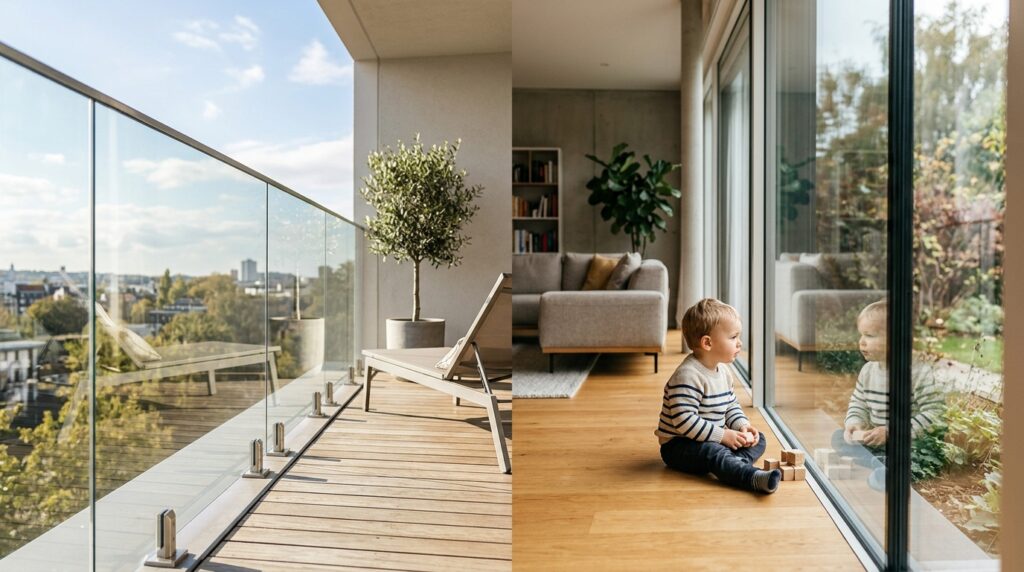
Tempered glass is the glass most people interact with every single day without knowing it. Walk into any modern gym, office or restaurant and you are surrounded by it. Shower doors and bathroom enclosures almost always use tempered glass because it handles heat, moisture and accidental bumps really well.
Glass tabletops in homes and offices use tempered glass because it resists scratches and supports weight without cracking easily. Glass partitions in open-plan commercial offices use it to give spaces a clean look while meeting safety glazing requirements at a reasonable cost. Side windows and rear windows in most cars are made of tempered glass too.
High-rise buildings and commercial buildings often choose tempered glass for their exterior windows where the main risk is accidental human contact with the glass. It meets all building code requirements for those locations and costs less than laminated glass, which makes it practical for very large-scale construction projects.
The Best Places to Use Laminated Glass
Laminated glass belongs wherever the glass breaking and falling out would create a serious danger. Car windshields are always laminated glass. In a crash, the windshield may crack but the PVB interlayer holds it in place. Glass falling onto a driver’s face at highway speed would be catastrophic.
Skylights and all overhead glazing above walking areas require laminated glass by law in most jurisdictions. Glass railings on stairs and balconies in commercial buildings also require it. Storefronts and commercial entry systems often use laminated glass for both safety and security since it is the only type that resists forced entry.
Banks, jewelry stores, hospitals and schools in high-risk urban areas specify laminated glass as a front-line protective measure. In hurricane zones across Florida, Texas and the Gulf Coast, impact-resistant laminated glass with a thick PVB interlayer is the standard choice for windows and doors because it can absorb hits from airborne debris and keep the building sealed during the storm.
Comparing Strength, Cost and Installation
Which One Is Actually Stronger?
This is the question I get asked most often and the honest answer is: it depends on what you mean by stronger. In terms of raw resistance before breaking, tempered glass wins. It is roughly four to five times stronger than annealed glass of the same size and thickness. It takes a solid and deliberate impact to shatter it.
But the moment it does break, it is completely gone. No barrier. No resistance. Nothing.
Laminated glass may crack under less force. But once it cracks, it is still working. The PVB interlayer holds the broken pieces together so the panel continues to act as a barrier. For security and post-break protection, laminated glass is clearly the better performer.
Some buildings combine both types into what is called tempered laminated glass. This uses tempered glass panels as the layers inside a laminated glass assembly. You get the initial strength of tempered glass plus the post-break containment of the PVB interlayer. It is the most expensive option by a significant margin but for high-security or overhead glazing in demanding projects it makes the most sense.
Cost and Installation: What to Expect
Both types cost more than plain annealed glass. That is just the reality of any safety glass product. Between the two, laminated glass is generally more expensive. It uses more raw materials and a more complex manufacturing process. It is also heavier than tempered glass of the same dimensions, which makes shipping and handling more costly.
Tempered glass is cheaper to produce and the installation process is faster for trained professionals. It is also lighter on average. However, all sizing and shaping must happen before tempering since you cannot cut or drill it afterward. Any mistake in the measurement means the whole piece needs to be redone.
Laminated glass is heavy and difficult to handle on-site. It is also hard to cut in the field. Any modifications to size or shape must be planned and ordered in advance. The installation itself takes longer and usually requires more people. For most standard projects like shower doors, regular windows and interior glass partitions, tempered glass delivers solid safety glass performance at a lower total cost. For skylights, security-sensitive storefronts and any glass above head height, the extra investment in laminated glass is absolutely worth it.
Conclusion
Understanding safety glass standards for tempered vs. laminated applications is not just knowledge for architects and contractors. If you are renovating a bathroom, fitting out an office or building anything with glass, these differences matter to you directly.
Tempered glass is strong, affordable and breaks into small safe pieces. It is the right choice for most everyday safety glazing needs. Laminated glass holds together after breaking and provides far better security and post-break containment. It is required by code in skylights, overhead glazing and many exterior applications in storm-prone regions.
When you pick your glass, look for the ANSI Z97.1 or CPSC marking etched onto the edge. That mark tells you the glass has been properly tested and certified. In a world where glass is literally everywhere around us, that small marking is one of the most important things you will never notice until you know to look for it. Have a project coming up? I would love to hear which type you ended up choosing and why.
Frequently Asked Questions
Can you combine tempered and laminated glass in one panel?
Yes and it is actually a well-known option called tempered laminated glass. Manufacturers use tempered glass panels as the inner layers of a laminated glass assembly. The result gives you the extra impact strength from the tempering process plus the post-break containment of the PVB interlayer. This combination is used in commercial buildings, overhead glazing and high-security applications where both strength and safety after breakage are required. It costs more than either type on its own but it offers the best protection available.
Is laminated glass always required for skylights?
In most US jurisdictions, yes. Building codes in the US, specifically IBC Section 2406, require laminated safety glass for skylights and any overhead glazing positioned above areas where people walk. The reason is simple. If tempered glass shatters in a skylight, the entire pane falls out of the frame and drops onto whoever is below. The PVB interlayer in laminated glass keeps the cracked pieces bonded together so they do not fall down. This is why tempered glass alone is not accepted in overhead positions in most local and state codes across the US.
Which glass type is better in hurricane-prone areas?
Laminated glass is the clear choice for hurricane-prone regions. It can take impacts from airborne debris driven by strong winds without breaking apart and leaving an opening in the building. Many states along the US Gulf Coast and Atlantic Coast have specific building codes that require impact-resistant laminated glass in all exterior windows and doors for homes and commercial buildings in high-wind zones. Tempered glass alone cannot provide the same level of protection against flying debris since once it shatters there is no barrier left.
Does laminated glass block UV rays?
Yes. Laminated glass blocks a significant amount of UV radiation. The PVB interlayer absorbs most UV light before it passes through the glass. This makes laminated glass an excellent choice for sun-facing windows in homes and offices because it helps protect furniture, flooring and fabrics from UV fading over time. It also contributes to making buildings more energy efficient by reducing solar heat gain through glazed areas. This UV-blocking benefit is one of the reasons laminated glass is popular for large windows in residential spaces that get a lot of direct sunlight.
Which type of safety glass costs less to install?
Tempered glass is generally the more affordable option both to purchase and to install. It is lighter than laminated glass and professional installers can work with it faster. Laminated glass costs more because of its multi-layer manufacturing process, its heavier weight and the longer time required for a proper installation. For standard projects like residential windows, shower doors and interior glass partitions, tempered glass delivers solid safety glazing performance at a better price point. For skylights, security-focused storefronts or exterior glass in storm-prone areas, the higher cost of laminated glass is a necessary and worthwhile investment.